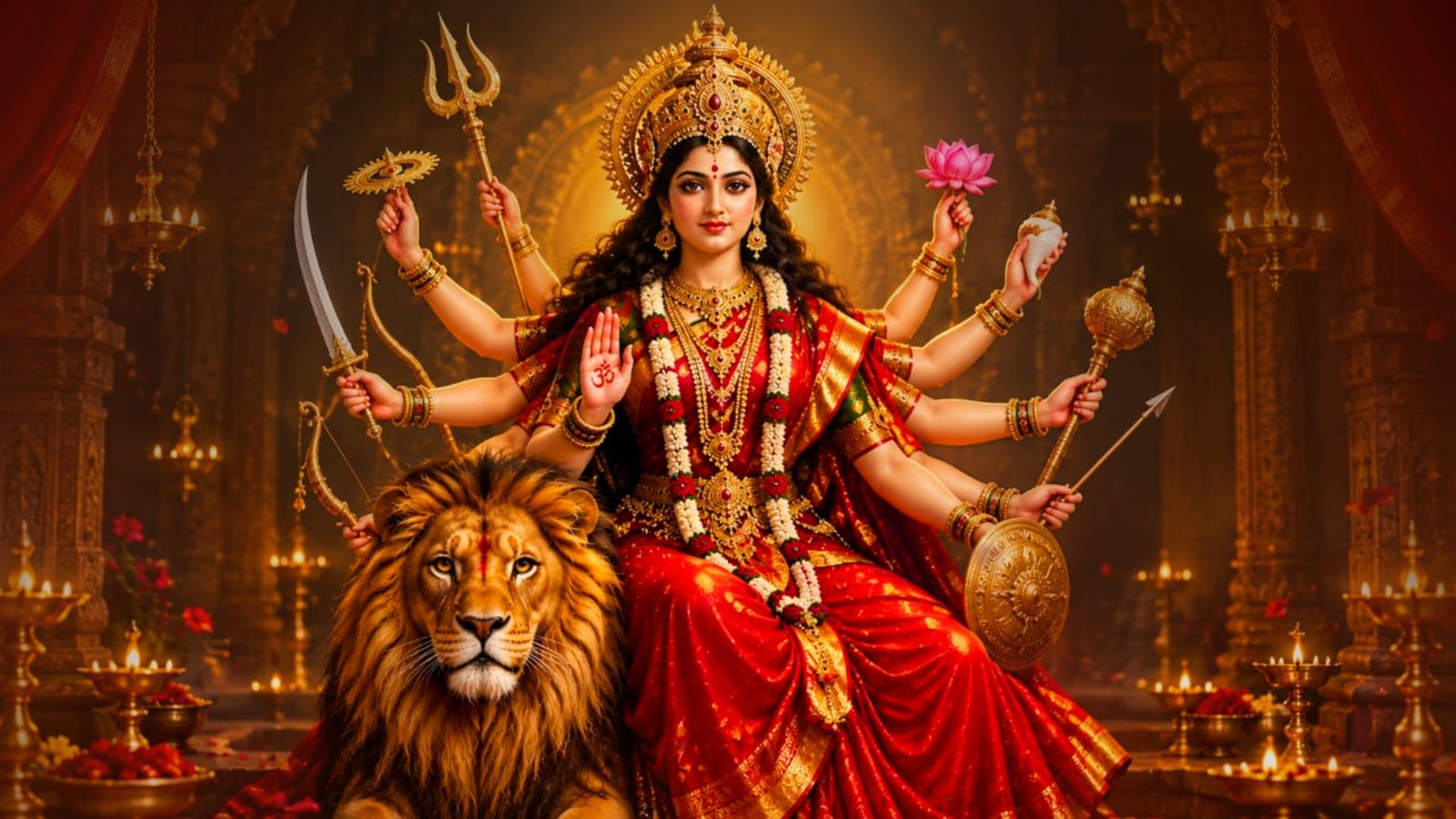
Navratri is one of the most important and widely celebrated festivals in India. The word Navratri literally means “nine nights”. These nine nights and ten days are dedicated to the worship of the Divine Mother and are celebrated in different ways across different parts of the country.
When we think of Navratri, many beautiful images come to mind — a sacred ghat placed in homes, a lamp burning continuously before the Goddess, beautifully decorated temples, devotional songs, traditional dances, colourful garba and dandiya, and the joyful atmosphere created by people coming together.
Although the style of celebration changes from one region to another, devotion towards the Goddess remains at the heart of the festival.
Navratri is not only a religious festival. It is also connected with mythology, history, traditional practices, folk culture, music, dance and community life. From Maharashtra and Gujarat to West Bengal, Karnataka and many other parts of India, Navratri takes different forms while preserving its connection with the worship of Shakti — the Divine Feminine power.
Let us understand the story, traditions and cultural importance of Navratri in a simple and detailed way.
Table of Contents
- The Mythological Story Behind Navratri
- Lord Rama and the Tradition of Akaal Bodhan
- The Nine Forms of Goddess Durga — Navadurga
- What Is Ghatasthapana?
- The Tradition of the Akhand Jyoti
- Navratri Celebrations in Maharashtra
- How Did Public Navratri Celebrations Develop?
- What Is Garba?
- Why Is Garba Performed in a Circle?
- Dandiya and Raas
- Traditional Garba
- Navratri in Different Parts of India
- Navratri and the Power of the Divine Feminine
- The Message of Navratri
- Why Is Navratri So Special?
- Jigyasa manthan…
- References
The Mythological Story Behind Navratri
One of the most well-known stories associated with Navratri is the story of Goddess Durga and the demon Mahishasura.
According to the Devi Mahatmya, found in the Markandeya Purana, Mahishasura was a powerful demon who had received a boon that made it difficult for the gods and others to defeat him. With his growing power, he began troubling the gods and disturbing the balance of the world.
The gods were unable to defeat him. According to the traditional account, their divine powers came together and manifested as Goddess Durga.
She appeared as a powerful form of Shakti and fought Mahishasura.
The battle between the Goddess and Mahishasura continued for nine days. Finally, Goddess Durga defeated and killed Mahishasura.
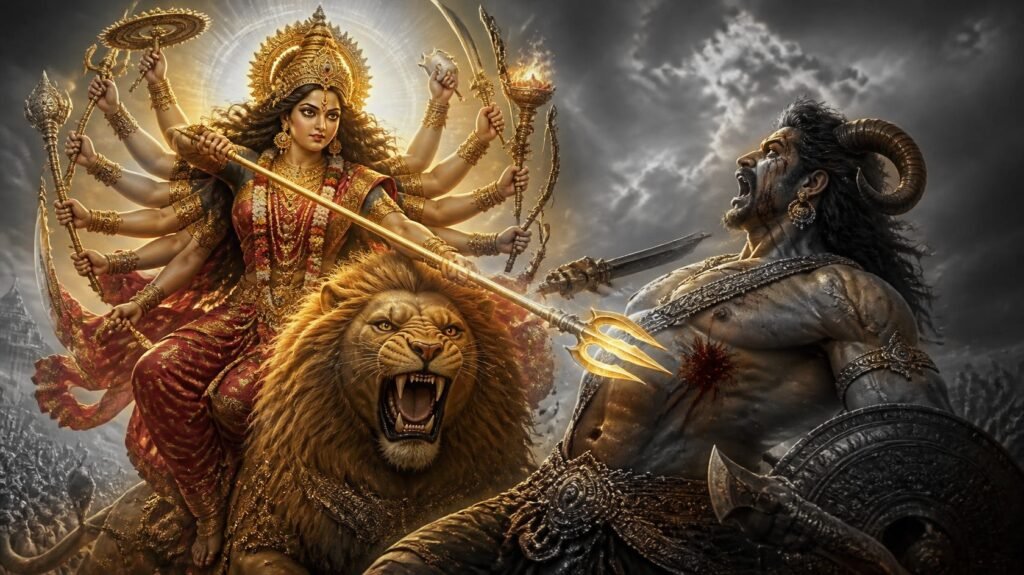
This victory of the Goddess over Mahishasura is remembered as a victory of divine power over evil.
The story of Durga and Mahishasura is one of the central traditions associated with the worship of the Goddess during Navratri.
Lord Rama and the Tradition of Akaal Bodhan
Another important tradition connected with Navratri is associated with Lord Rama.
According to the Akaal Bodhan tradition, Lord Rama worshipped Goddess Durga before fighting Ravana. The worship is traditionally associated with a time outside the Goddess’s usual period of worship.
Therefore, it came to be known as Akaal Bodhan, meaning the invocation or awakening of the Goddess at an unusual time.
The story of Lord Rama worshipping Goddess Durga before the battle with Ravana is found in the popular Akaal Bodhan tradition and is also associated with the Krittivasi Ramayana.
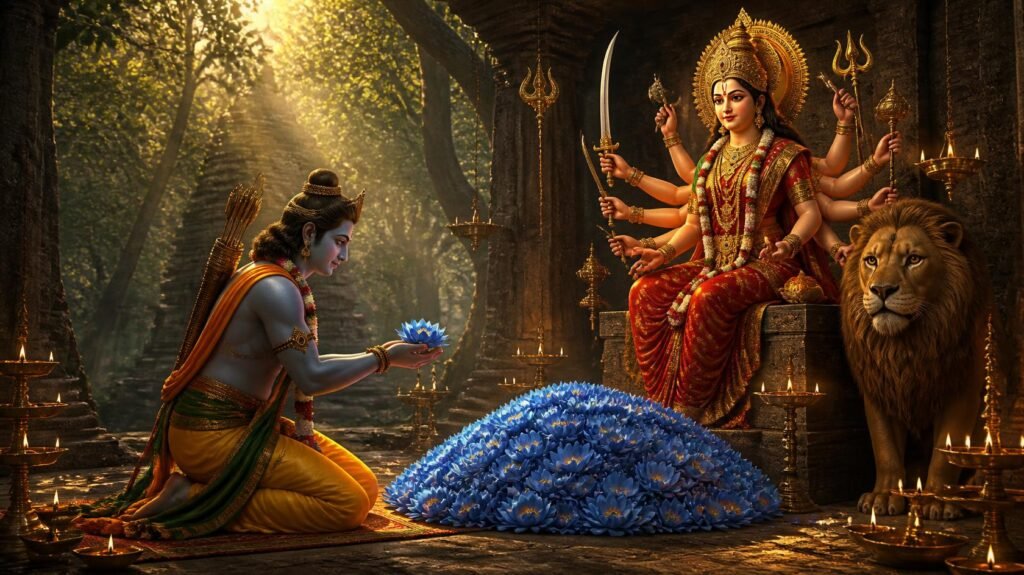
According to the legend, Lord Rama resolved to worship Goddess Durga with 108 rare blue lotuses (Neel Kamal) to invoke her divine grace. Lord Hanuman travelled across the world and gathered the flowers, but to test Rama’s deep devotion, the Goddess secretly hid one lotus.
During the final rituals, Lord Rama realized he was short of exactly one flower. A paused ritual would mean failure, but Lord Rama refused to give up.
He suddenly remembered that his mother, Mata Kaushalya, often fondly referred to him as Kamalanayana (the one with lotus-like eyes).
With complete surrender and devotion, Lord Rama raised an arrow, prepared to gouge out his own blue eye to offer it as the 108th lotus.
Touched by his supreme sacrifice, Goddess Durga instantly manifested before him, held his hand, and stopped him. She accepted his profound prayers and blessed him with the ultimate boon of victory over Ravana.
This tradition is especially connected with the Durga Puja celebrations of Bengal.
Thus, the Navratri and Durga Puja traditions are connected not only with the story of Goddess Durga and Mahishasura, but also with the story of Lord Rama seeking the blessings of the Divine Mother before his great battle.
The Nine Forms of Goddess Durga — Navadurga
The nine forms of Goddess Durga worshipped during Navratri are collectively known as the Navadurga.
Each day of Navratri is traditionally associated with one form of the Goddess.
1. Shailaputri
Shailaputri is worshipped on the first day of Navratri.
The name Shailaputri means “daughter of the mountain”. She is traditionally identified with the daughter of the Himalayas and is worshipped as a form of Goddess Parvati.
She is usually depicted riding a bull and carrying a trident and a lotus.
2. Brahmacharini
Brahmacharini is worshipped on the second day.
She represents the form of the Goddess associated with devotion, penance and spiritual discipline.
She is traditionally shown carrying a rosary and a water pot.
3. Chandraghanta
Chandraghanta is worshipped on the third day.
She is traditionally depicted with a crescent moon on her forehead. Because of this, she is known as Chandraghanta.
She is associated with courage, strength and the protective form of the Goddess.
4. Kushmanda
Kushmanda is worshipped on the fourth day.
According to traditional belief, Goddess Kushmanda is associated with the creation and nourishment of the universe.
She is depicted with several arms and is traditionally worshipped as a powerful form of the Divine Mother.
5. Skandamata
Skandamata is worshipped on the fifth day.
She is known as the mother of Skanda, another name for Lord Kartikeya.
She is traditionally depicted holding Lord Skanda in her lap and riding a lion.
6. Katyayani
Katyayani is worshipped on the sixth day.
She is regarded as a powerful form of Goddess Durga.
The name Katyayani is traditionally associated with Sage Katyayana and the story of the Goddess appearing in response to his devotion.
7. Kalaratri
Kalaratri is worshipped on the seventh day.
She represents a fierce form of the Goddess.
Her appearance is traditionally described as dark and powerful. Although this form may appear frightening, devotees worship Kalaratri as a protective form of the Divine Mother who destroys evil and removes fear.
8. Mahagauri
Mahagauri is worshipped on the eighth day.
She is associated with purity, peace and a gentle form of the Goddess.
The name Mahagauri refers to her extremely fair and radiant appearance in traditional descriptions.
9. Siddhidatri
Siddhidatri is worshipped on the ninth day.
She is traditionally regarded as the Goddess who grants siddhis, or spiritual powers and accomplishments.
Devotees worship her as the final form of the Navadurga during Navratri.
The worship of these nine forms gives Navratri a special spiritual and devotional structure.
What Is Ghatasthapana?
The beginning of Navratri is traditionally marked by Ghatasthapana, also known as Kalash Sthapana in many places.
A sacred pot or kalash is placed at a chosen place in the home or temple according to local tradition and religious practice.
The kalash is decorated and worshipped as part of the Navratri rituals. In many traditions, grains or barley are also sown near the kalash. These grow during the nine days and are considered part of the sacred ritual.
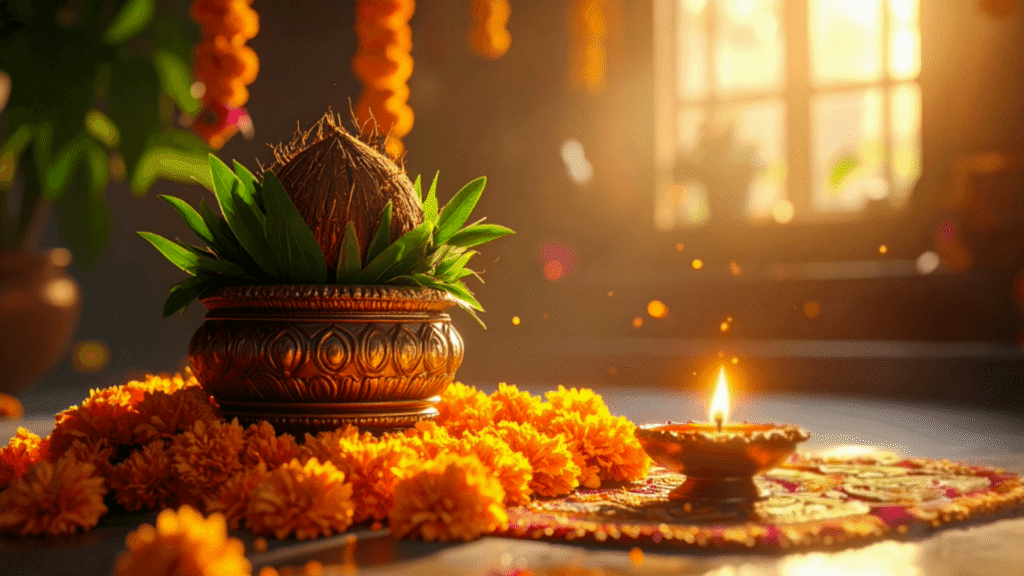
Ghatasthapana marks the formal beginning of the Navratri worship.
The exact rituals, timings and methods may vary from region to region and according to family traditions.
The Tradition of the Akhand Jyoti
In many homes and temples, a lamp is lit at the beginning of Navratri and kept burning continuously throughout the nine days.
This is traditionally known as Akhand Jyoti or Akhand Deep.
Lighting a lamp has an important place in Hindu worship, and during Navratri many devotees maintain an uninterrupted lamp as part of their devotional practice.
The way the lamp is maintained may differ according to family and regional traditions. For devotees, it becomes an important part of the atmosphere of Navratri worship.
Navratri Celebrations in Maharashtra
Navratri is celebrated with great devotion in Maharashtra.
The installation of the Goddess, Ghatasthapana, daily worship, devotional programmes and visits to temples are common parts of the festival.
Different regions and families follow their own customs.
Maharashtra also has a beautiful folk tradition associated with Navratri known as Bhondla.
What Is Bhondla?
Bhondla is a traditional women’s and girls’ folk celebration associated with the period of Navratri, especially in Maharashtra.
During Bhondla, girls and women traditionally gather together and sing folk songs while forming a circle around a decorated object or symbolic representation, often associated with the elephant.
The songs, games and customs connected with Bhondla are passed from one generation to another.
Bhondla is therefore not only a form of entertainment. It is also a part of Maharashtra’s traditional folk culture and community life.
The exact customs may vary from region to region and from one family tradition to another.
How Did Public Navratri Celebrations Develop?
Navratri has been celebrated in India for centuries as a religious and cultural festival.
Over time, the form of public celebration developed differently in different regions.
In some places, worship remained mainly centred around homes and temples, while in other places, community celebrations became an important part of the festival.
Public celebrations brought people together through religious programmes, music, dance, decorations and cultural activities.
The tradition of community participation can be seen particularly strongly in celebrations such as Durga Puja in Bengal and Garba celebrations in Gujarat.
The Barowari Tradition in Bengal
West Bengal is famous for its grand Durga Puja celebrations.
The tradition of community-based Durga Puja is associated with the Barowari or community tradition.
The word Barowari is traditionally connected with the idea of collective or community-organised worship.
Over time, Durga Puja became a major social and cultural celebration in Bengal.
Large pandals, artistic decorations, traditional rituals, cultural programmes and community participation make the festival a major part of Bengali culture.
Kolkata’s Durga Puja is now recognised internationally as an important cultural tradition and was inscribed on UNESCO’s Representative List of the Intangible Cultural Heritage of Humanity in 2021.
What Is Garba?
Garba is one of the most famous traditional dances associated with Navratri.
It is particularly popular in Gujarat, although it is now enjoyed in many parts of India and around the world.
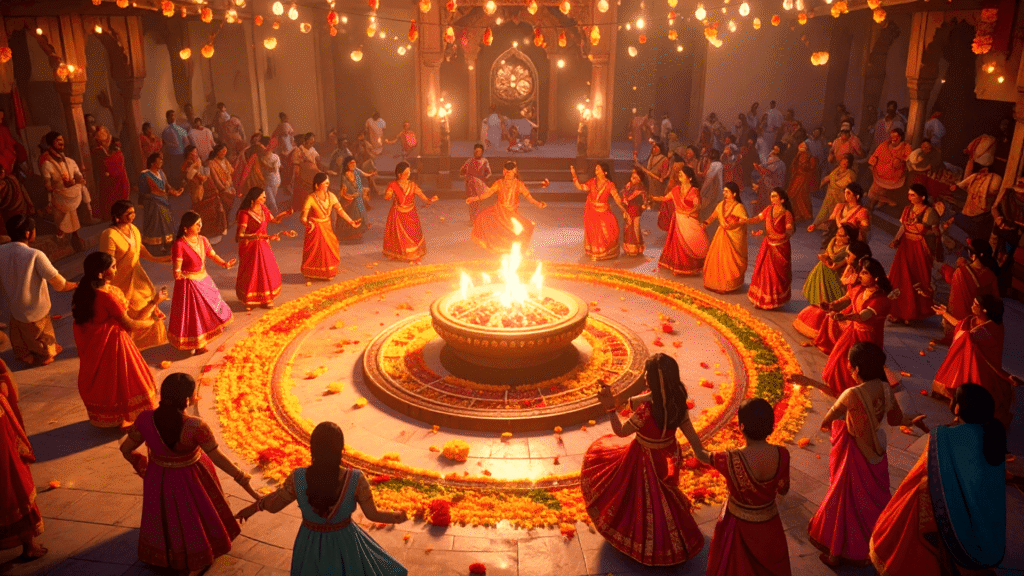
During Navratri, people gather in large numbers, dress in traditional or colourful clothes and dance together to devotional and folk music.
The traditional form of Garba is closely connected with the worship of the Divine Mother.
A decorated earthen pot, often known as a garbo, has traditionally been used in Garba celebrations.
The dance is performed around a central point, which may represent the sacred presence of the Goddess or a lamp.
Garba is therefore much more than just a modern dance event. It has deep roots in Gujarat’s folk and devotional traditions.
The traditional Garba of Gujarat was inscribed on UNESCO’s Representative List of the Intangible Cultural Heritage of Humanity in 2023.
Why Is Garba Performed in a Circle?
One of the most noticeable features of Garba is its circular movement.
People dance in a circle around the central lamp, pot or symbolic representation.
The circular form is an important part of the traditional dance style. It creates a sense of togetherness because everyone participates in the same movement and remains connected to the group.
The central point remains important while the dancers move around it.
Different traditional and regional explanations are associated with the circular form of Garba. Therefore, it is better to understand it as part of the traditional form and devotional setting of Garba rather than attaching one fixed interpretation to it.
Dandiya and Raas
Dandiya is another popular dance associated with Navratri, especially with Gujarat.
It is traditionally performed using decorated wooden sticks.
The dance is often performed in pairs or groups, with participants moving rhythmically and striking the sticks in coordination with the music.
Dandiya is closely connected with the traditional dance forms of Gujarat and is also associated with Raas traditions.
Today, Dandiya and Garba have become popular far beyond Gujarat. Large community events are organised in many Indian cities and even in other countries.
Traditional Garba
Traditional Garba has a strong connection with devotion to the Divine Mother.
Earlier forms of Garba were closely connected with local communities, devotional songs and traditional customs.
The dance was not simply a performance for an audience. People participated together as part of the celebration.
Over time, Garba has changed in many places. Modern music, large events, stage performances and new styles have become part of contemporary Navratri celebrations.
However, traditional Garba continues to remain an important part of Gujarat’s cultural identity.
Navratri in Different Parts of India
One of the most beautiful things about Navratri is the variety of ways in which it is celebrated across India.
Gujarat
Gujarat is especially famous for Garba and Dandiya Raas.
People gather in large numbers during the nine nights and participate in traditional dances, devotional programmes and community celebrations.
West Bengal
In West Bengal, the festival is celebrated mainly as Durga Puja.
Goddess Durga is worshipped with great devotion, and beautifully decorated pandals become centres of community life.
Kolkata is particularly famous for its grand Durga Puja celebrations.
Maharashtra
In Maharashtra, Navratri includes Ghatasthapana, worship of the Goddess, temple visits, devotional activities and folk traditions such as Bhondla.
Karnataka
Karnataka is famous for the grand Mysuru Dasara celebrations.
The festival is strongly associated with the worship of Goddess Chamundeshwari, the presiding deity of Mysuru.
The Mysuru Dasara tradition has a long historical and cultural significance.
Northern and Other Parts of India
In many northern parts of India, Navratri is observed through fasting, worship, devotional gatherings and temple visits.
The festival is also closely connected with the traditions of Ram Navami and Dussehra in different regions, although the exact customs and sequence of celebrations vary.
Thus, the same festival takes many different forms across India.
Navratri and the Power of the Divine Feminine
The worship of the Goddess is at the centre of Navratri.
The festival reminds devotees of the importance of Shakti — the Divine Feminine power worshipped in many forms.
Goddesses such as Durga, Lakshmi, Saraswati, Parvati and many regional forms of the Divine Mother have an important place in Hindu traditions.
During Navratri, the Goddess is worshipped in different forms, and each region has its own customs, stories and devotional practices.
This makes Navratri an important part of India’s spiritual and cultural heritage.
The Message of Navratri
The stories and traditions associated with Navratri carry a message of devotion, courage and faith.
The story of Goddess Durga and Mahishasura is traditionally remembered as the victory of the Goddess over evil.
The worship of the Goddess during the nine nights brings devotees together through prayer, fasting, rituals, music and cultural traditions.
For many families, Navratri is also a time to maintain traditional practices and pass them on to younger generations.
The festival therefore connects religious faith with family traditions and community life.
Why Is Navratri So Special?
Navratri is special because it brings many aspects of Indian culture together.
- Devotion
- Worship of Shakti
- Mythological traditions
- Family customs
- Folk culture
- Music and dance
- Community participation
- Traditional food and fasting
- Regional diversity
From a small lamp burning in a home to thousands of people dancing together during Garba, Navratri can be experienced in many different ways.
The forms may be different, but the spirit of devotion remains at the centre.
Navratri also shows how India’s traditions have continued to live through generations. Each region has preserved its own customs while remaining connected to the larger tradition of worshipping the Divine Mother.
Jigyasa manthan…
Navratri is much more than a festival of nine nights.
It is a beautiful combination of devotion, mythology, history, folk traditions, music, dance and community life.
The story of Goddess Durga and Mahishasura, the tradition of Lord Rama’s worship of Goddess Durga, the worship of the Navadurga, Ghatasthapana, Akhand Jyoti, Bhondla, Garba, Dandiya and Durga Puja — all form different parts of the rich cultural world of Navratri.
The way Navratri is celebrated may differ from Maharashtra to Gujarat, from Bengal to Karnataka and from one family to another. Yet, the devotion towards the Divine Mother remains a common thread.
A small lamp lit before the Goddess and a Garba circle filled with thousands of devotees may look very different, but both carry the spirit of devotion and celebration.
Navratri reminds us to respect our traditions, understand the stories behind them and pass their cultural beauty to future generations.
May the blessings of the Divine Mother always be with everyone.
Jai Mata Di!.. 🙏
References
- Devi Mahatmya (Durga Saptashati) — Part of the Markandeya Purana, for the traditional account of Goddess Durga and Mahishasura.
- Krittivasi Ramayana — For the tradition of Akaal Bodhan associated with Lord Rama’s worship of Goddess Durga.
- UNESCO Intangible Cultural Heritage — Kolkata Durga Puja and Garba of Gujarat.
- Mysuru Dasara – Official Information — For the Mysuru Dasara and Chamundeshwari tradition.