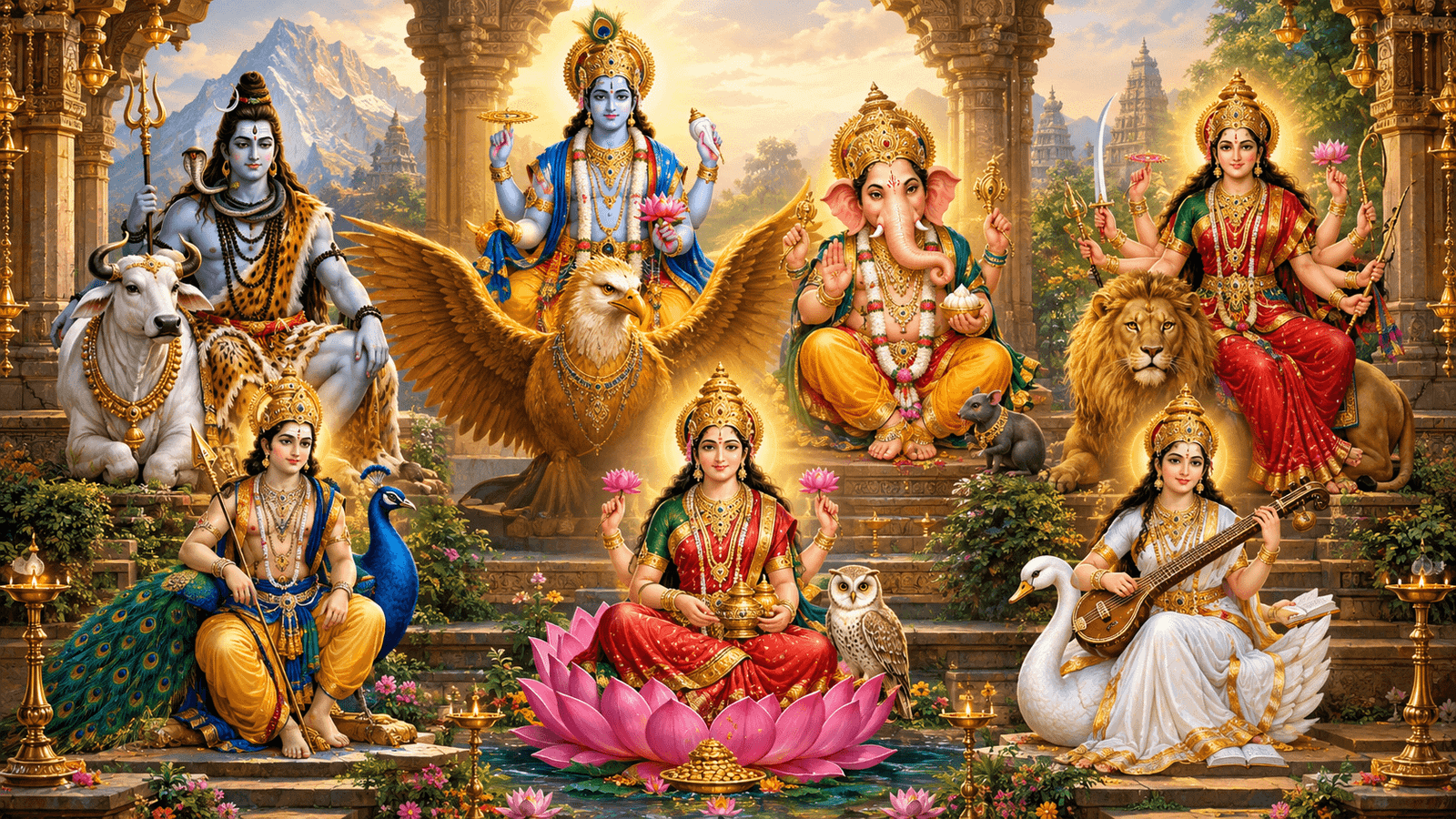
When we look at traditional images of Hindu deities or visit a Hindu temple, we often notice something special.
Lord Ganesha is shown with a mouse.
Lord Shiva is associated with Nandi, the sacred bull.
Lord Vishnu is associated with Garuda.
Goddess Durga is traditionally shown with a lion, while some traditions also depict Her with a tiger.
Lord Kartikeya is associated with the peacock.
These animals and birds are not simply decorative figures placed beside the deities. They have an important place in Hindu religious traditions and are traditionally known as the vahanas of the deities.
But what exactly is a vahana?
Why is a particular animal or bird associated with a particular deity?
How did these associations become part of Hindu tradition?
And are the same vehicles mentioned in every Hindu scripture and tradition?
These are interesting questions, especially because Hindu religious traditions have developed through many scriptures, Puranas, temple traditions, regional practices, and forms of worship.
So, before looking at the stories behind these divine vehicles, let us first understand some of the best-known traditional associations.
Table of Contents
- What Does the Word “Vahana” Mean?
- Lord Shiva and Nandi
- Lord Vishnu and Garuda
- Lord Ganesha and Mushaka
- Goddess Durga and the Lion or Tiger
- Lord Kartikeya and the Peacock
- Goddess Lakshmi and the Owl
- Goddess Saraswati and the Hamsa
- Devaraja Indra and Airavata
- Yamaraja and the Buffalo
- Shani Dev and the Crow
- A Quick Look at Some Major Deities and Their Traditional Vehicles
- Why Do Different Traditions Sometimes Describe Different Vehicles?
- Are the Vehicles Only Symbols?
- The Stories Behind These Divine Vehicles
- What Will We Explore in the Next Articles?
- In Short
What Does the Word “Vahana” Mean?
The Sanskrit word vahana refers broadly to something that carries or serves as a means of transport.
In Hindu religious traditions and sacred art, a deity’s vahana is the animal, bird, or divine being associated with that deity as a revered mount or vehicle. For many deities, the vahana has become an inseparable and vital part of their traditional representation.
For instance, when devotees see Nandi facing a Shiva shrine, Garuda accompanying Lord Vishnu, or a mouse near Lord Ganesha, these are not mere artistic choices—they belong to deeply rooted religious and iconographic traditions.
At the same time, it is beautiful to note the vast diversity within Hindu traditions.
While some divine associations are described directly in the Puranas, others hold a prominent place through regional traditions, temple practices, sacred art, or devotional literature.
Therefore, rather than looking for a single uniform scriptural source for every explanation, we can appreciate how each interpretation reflects the rich tapestry of scriptural wisdom and living traditions.
With that respectful understanding in mind, let us explore some of the most widely revered divine vehicles.
1. Lord Shiva and Nandi
When devotees think of Lord Shiva, one of the first figures they often notice is Nandi, the sacred bull.
Nandi has a deeply respected place in Shaiva tradition and is traditionally associated with Lord Shiva as His bull and devoted attendant.
In many Shiva temples, a statue of Nandi is placed facing the shrine of Lord Shiva. Devotees often see Nandi seated calmly and facing the Shiva Linga.
The association between Lord Shiva and Nandi is therefore an important part of traditional Shaiva worship and temple iconography.
Puranic literature also describes the sacred bull as the vehicle associated with Lord Shiva and Goddess Parvati.
The stories connected with Nandi are themselves extensive and belong to the wider traditions surrounding Lord Shiva.
Rather than trying to explain all of them in this overview, we will explore the traditional stories of Nandi separately in a future article.
2. Lord Vishnu and Garuda
Garuda is one of the most famous divine beings in Hindu tradition and is closely associated with Lord Vishnu.
Garuda is traditionally described as a powerful divine bird-like being. His stories appear in important Hindu texts, including the Mahabharata and the Puranas.
Garuda is traditionally described as the son of Sage Kashyapa and Vinata.
One of the famous stories connected with Garuda tells of his extraordinary strength and his effort to obtain the nectar of immortality in order to free his mother from bondage.
Garuda’s relationship with Lord Vishnu is an important part of Vaishnava tradition.
In traditional religious art, Lord Vishnu is often shown riding upon Garuda or accompanied by Him.
The association is also clearly reflected in Puranic literature, where Garuda is described as the vehicle of Lord Vishnu.
The complete story of how Garuda became associated with Lord Vishnu is itself a fascinating subject and will be explored separately.
3. Lord Ganesha and Mushaka
Perhaps one of the most familiar divine vehicles is Mushaka, the mouse associated with Lord Ganesha.
In traditional images of Lord Ganesha, the small mouse is often shown near His feet.
But how did a mouse become associated with Lord Ganesha?
Different Hindu traditions contain different versions of the story.
One well-known tradition connects Mushaka with the story of Krauncha, whose transformation into a mouse is associated with Lord Ganesha.
After becoming associated with Lord Ganesha, Mushaka is traditionally shown as His vehicle.
The association between Lord Ganesha and the mouse is not merely a modern artistic idea. Puranic literature contains descriptions of Lord Ganesha riding a mouse.
However, the exact details of the story can vary between texts and traditions.
This is why, in our future detailed article, we will look carefully at the traditional story and identify which version belongs to which source.
4. Goddess Durga and the Lion or Tiger
When we think of Goddess Durga, we often picture Her riding a powerful lion.
The lion is one of the most widely recognized animals associated with Goddess Durga in Hindu religious art and tradition.
At the same time, some regional and artistic traditions depict Goddess Durga with a tiger.
Therefore, it is better to acknowledge both forms rather than suggesting that every Hindu tradition represents Her in exactly the same way.
The association of Goddess Durga with the lion is especially prominent in depictions of Mahishasura Mardini, the form of the Goddess who defeats the buffalo demon Mahishasura.
The story of Goddess Durga’s battle with Mahishasura is prominently described in the Devi Mahatmya, which forms part of the Markandeya Purana.
The lion therefore has an important place in the traditional iconography of Goddess Durga.
The complete story surrounding Goddess Durga, Mahishasura, and Her divine mount deserves a separate article because different traditions and representations add their own details.
5. Lord Kartikeya and the Peacock
Lord Kartikeya, also known as Skanda, Kumara, and Murugan in different traditions, is traditionally associated with the peacock.
This association is especially prominent in South Indian traditions devoted to Lord Murugan.
Lord Kartikeya is frequently depicted standing on or riding a peacock.
Puranic literature contains descriptions of the peacock as Lord Kartikeya’s vehicle. In one account from the Skanda Purana, a peacock is given to Kartikeya as His vehicle.
The peacock has therefore become an important part of the traditional representation of Lord Kartikeya.
The story of how Lord Kartikeya received His peacock is one of the stories that we can explore in detail later in this series.
6. Goddess Lakshmi and the Owl
Goddess Lakshmi, who is revered as the Goddess associated with prosperity, abundance, and good fortune, is widely associated with the owl in popular Hindu tradition and religious iconography.
The owl is particularly familiar in traditional depictions of Goddess Lakshmi during festivals such as Diwali.
However, this association should be understood carefully.
Hindu traditions surrounding Goddess Lakshmi are diverse, and Her forms and associations can vary across different texts, regions, and traditions.
Therefore, in this article, it is more appropriate to describe the owl as a widely recognized traditional association of Goddess Lakshmi rather than claiming that every Hindu scripture describes the owl as Her vehicle in exactly the same way.
The detailed traditions surrounding Goddess Lakshmi and the owl can be explored separately.
7. Goddess Saraswati and the Hamsa
Goddess Saraswati is revered as the Goddess associated with knowledge, learning, music, and the arts.
She is traditionally associated with the hamsa, commonly represented in English as a swan.
Traditional images of Goddess Saraswati often show Her seated with or beside a white hamsa while holding the veena.
In some regional and artistic traditions, Goddess Saraswati is also represented with a peacock.
Therefore, the hamsa is one of the most widely recognized traditional associations of Goddess Saraswati, while other representations also exist.
It is important, however, not to take later symbolic explanations and present them automatically as direct statements from a particular scripture.
In our future articles, we will focus first on what the relevant traditions and texts actually say.
8. Devaraja Indra and Airavata
Devaraja Indra, traditionally regarded as the king of the Devas, is closely associated with Airavata, the magnificent divine elephant.
Airavata is one of the best-known elephants in Hindu tradition.
In Puranic literature, Airavata is repeatedly described as the elephant associated with Lord Indra.
Airavata is also connected with the tradition of the Samudra Manthana, or churning of the cosmic ocean.
The stories surrounding Airavata differ in their details across Hindu literature, which is why the complete account is better explored separately.
9. Yamaraja and the Buffalo
Yamaraja, traditionally regarded as the lord associated with death and the judgment of beings after death, is commonly depicted riding a buffalo.
The buffalo is an established part of the traditional iconography associated with Yamaraja.
Puranic literature contains clear descriptions of Yamaraja riding a buffalo.
Yamaraja has an important place in Hindu religious thought and literature, particularly in traditions concerning death, karma, and the consequences of actions.
The stories connected with Yamaraja and His vehicle will be explored separately.
10. Shani Dev and the Crow
Shani Dev, traditionally associated with the planet Saturn, is widely represented with a crow in Hindu religious tradition and iconography.
The crow is especially familiar in temples and devotional traditions dedicated to Shani Dev.
However, as with several other divine vehicles, representations can vary between regional traditions.
Therefore, the crow is best described here as a widely recognized traditional association of Shani Dev.
The stories and traditions connected with Shani Dev and the crow can be explored in a separate article.
A Quick Look at Some Major Deities and Their Traditional Vehicles
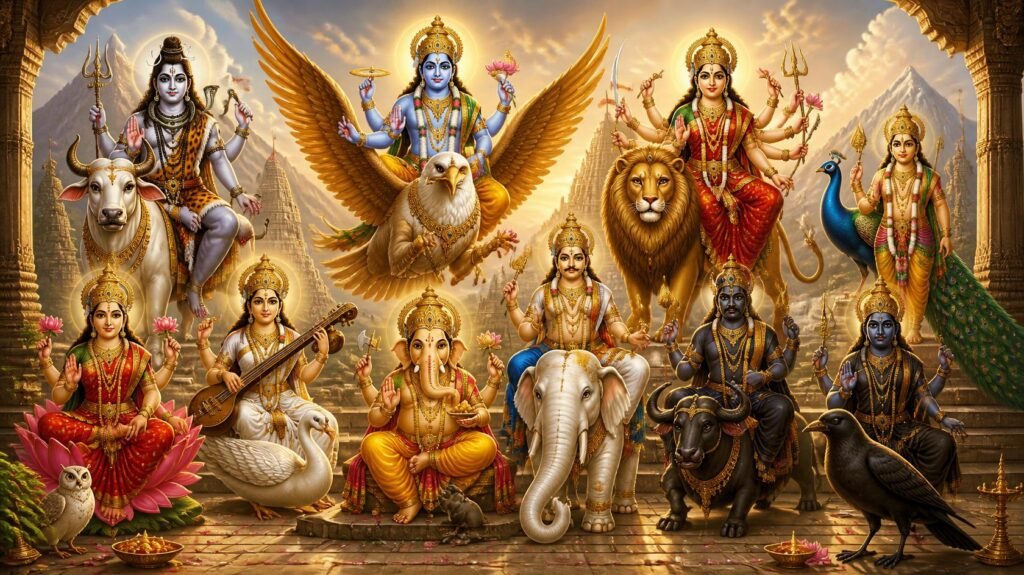
| Deity | Traditional Vehicle or Association |
|---|---|
| Lord Shiva | Nandi, the sacred bull |
| Lord Vishnu | Garuda |
| Lord Ganesha | Mushaka, the mouse |
| Goddess Durga | Lion; tiger in some traditions |
| Lord Kartikeya | Peacock |
| Goddess Lakshmi | Owl in widely known traditions |
| Goddess Saraswati | Hamsa (swan); peacock in some traditions |
| Devaraja Indra | Airavata, the divine elephant |
| Yamaraja | Buffalo |
| Shani Dev | Crow in widely known traditions |
Why Do Different Traditions Sometimes Describe Different Vehicles?
This is an important point to understand before we go deeper into these stories.
Hindu religious tradition is vast. It includes the Vedas, Upanishads, Itihasas, Puranas, Agamas, regional traditions, temple practices, devotional literature, and many different schools of worship.
Because of this, the way a deity is represented can sometimes vary from one text, region, or tradition to another.
For example:
- Goddess Durga may be shown with a lion or a tiger.
- Goddess Saraswati is commonly associated with the hamsa, while some traditions also show Her with a peacock.
- Goddess Lakshmi is widely associated with an owl in popular tradition.
- Shani Dev is widely associated with a crow, while other traditional representations may also be found.
These differences should be understood in their proper context.
They are part of the rich diversity of Hindu religious traditions and artistic representations.
Are the Vehicles Only Symbols?
Today, we often come across explanations that give a symbolic meaning to every divine vehicle.
For example, someone may say that Lord Ganesha’s mouse represents the restless mind, or that Goddess Durga’s lion represents a particular human quality.
Such explanations may be found in devotional teachings, later interpretations, or modern discussions.
However, we should be careful not to present every such interpretation as though it were directly stated in a particular Purana or scripture.
That is not the approach we will follow in this series.
Our first focus will be on the traditional stories and sources.
If a particular symbolic interpretation is clearly found in a recognized religious tradition, it can be discussed separately. But we will not present our own interpretation as a scriptural teaching.
The Stories Behind These Divine Vehicles
Knowing the names of the vehicles is only the beginning.
Behind many of these associations are fascinating traditional stories involving Devas, Asuras, sages, divine beings, battles, blessings, vows, and extraordinary events.
For example:
- How did Mushaka become the vehicle of Lord Ganesha?
- How did Garuda become associated with Lord Vishnu?
- How did Nandi become associated with Lord Shiva?
- How did Airavata become the vehicle of Devaraja Indra?
- What are the traditional stories connected with Goddess Durga and Her lion?
- How did Lord Kartikeya receive the peacock as His vehicle?
These are not questions that can always be answered in a single paragraph.
Some stories have more than one version, and some associations are preserved mainly through particular regional or devotional traditions.
That is why each important deity and vehicle deserves its own detailed article.
What Will We Explore in the Next Articles?
In the upcoming articles, we will take these divine vehicles one by one.
Instead of simply telling you which animal or bird is associated with a deity, we will explore the story behind that association.
For each deity, we will try to understand:
- What is the traditional story?
- Which Hindu text or tradition contains it?
- How did the vehicle become associated with the deity?
- Are there different versions of the story?
- Which details come directly from scripture?
- Which details belong to later or regional traditions?
- How did the association become part of Hindu religious art and worship?
This will allow us to understand these traditions with respect, care, and attention to their original context.
In Short
The divine vehicles of Hindu deities are an important part of Hindu religious traditions, temple art, sculpture, storytelling, and devotional practice.
Lord Shiva is traditionally associated with Nandi.
Lord Vishnu is associated with Garuda.
Lord Ganesha is associated with Mushaka.
Goddess Durga is traditionally shown with a lion, while some traditions depict Her with a tiger.
Lord Kartikeya is associated with the peacock.
Goddess Lakshmi is widely associated with the owl in popular tradition.
Goddess Saraswati is traditionally associated with the hamsa, with other representations also found.
Devaraja Indra is associated with Airavata.
Yamaraja is associated with the buffalo.
And Shani Dev is widely associated with the crow.
But knowing these names is only the beginning.
The more interesting question is:
How did each of these divine beings become associated with their respective deity?
That is where the traditional stories begin.
References
The traditions concerning divine vehicles are found across different Hindu scriptures, Puranic literature, temple traditions, and religious iconography. Some useful sources for this subject include:
- Shiva Purana — traditions concerning Lord Shiva, Nandi, and Lord Ganesha
- Skanda Purana — traditions concerning Lord Kartikeya and other sacred narratives
- Devi Bhagavata Purana — descriptions of several Devas and their traditional vehicles
- Srimad Bhagavata Mahapurana — traditions concerning Lord Vishnu, Garuda, Devaraja Indra, Airavata, and Yamaraja
- Mahabharata — important narratives concerning Garuda and other divine beings
- Devi Mahatmya (Markandeya Purana) — the traditions surrounding Goddess Durga and Mahishasura Mardini
- Traditional Hindu temple iconography and regional devotional traditions
Note: Hindu scriptures and regional traditions may sometimes describe particular details differently. Where such differences exist, they are best understood in the context of the specific text or tradition rather than treated as a contradiction.