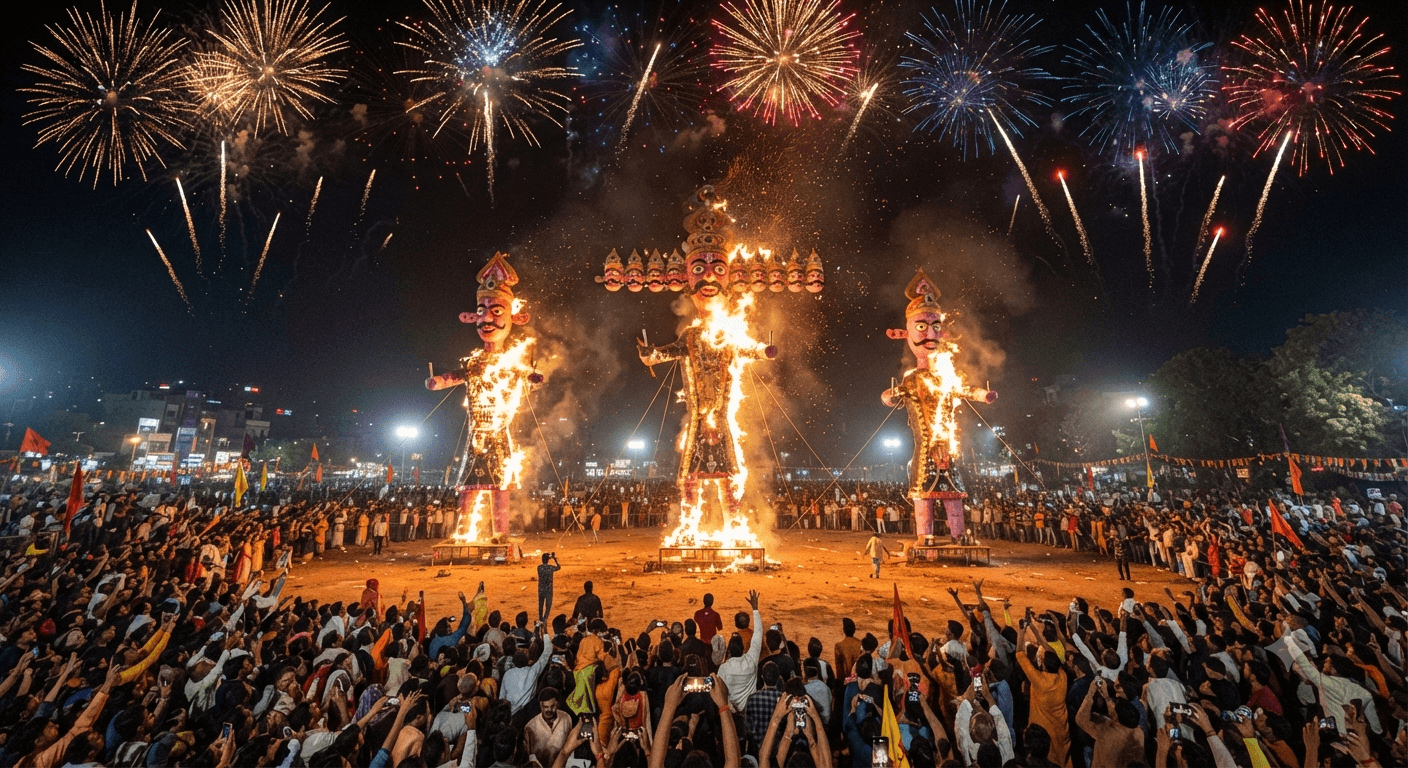
Dussehra is one of the most important and joyful festivals in Indian culture. Celebrated on the tenth day of the bright fortnight of the Hindu month of Ashwin, it is also known as Vijayadashami. After the nine days of Navratri, people across Maharashtra and many other parts of India celebrate this festival with great enthusiasm. On this day, devotees worship the Goddess, people honour their weapons and tools, Apta leaves (Bauhinia racemosa) are exchanged as a symbol of gold, and younger family members seek the blessings of their elders.
Dussehra is not just a day for worship, shopping, or exchanging Apta leaves. It symbolises the victory of good over evil, truth over falsehood, and justice over injustice. This is why the festival is also known as Vijayadashami, which signifies the victory celebrated on the tenth day.
But what is the religious and cultural significance of Dussehra? How is the victory of Goddess Durga over Mahishasura connected to this festival? What is the relationship between Lord Rama’s victory over Ravana and Vijayadashami? How did the tradition of exchanging Apta leaves as gold begin? Why are Shami tree worship and Seemollanghan considered important on this day? And why is Dussehra regarded as one of the three-and-a-half auspicious occasions in the Hindu tradition?
Let us explore the answers to these questions and learn about the other important traditions associated with Dussehra in simple language.
Table of Contents
- What Is Dussehra? What Is the Significance of Vijayadashami?
- Four Major Mythological Stories Associated with Dussehra
- Are the Apta and Shami Trees the Same?
- What Rituals Are Performed on Dussehra?
- What Is Seemollanghan? Why Is It Observed on Dussehra?
- Why Is Dussehra Considered One of the Three-and-a-Half Auspicious Muhurats?
- Why Do People Buy Gold and Start New Ventures on Dussehra?
- How Is Dussehra Celebrated in Different Parts of India?
- Frequently Asked Questions About Dussehra
- The Message of Dussehra….
1. What Is Dussehra? What Is the Significance of Vijayadashami?
According to the Hindu calendar, Dussehra is celebrated on the tenth day of the bright fortnight of the month of Ashwin. The bright fortnight refers to the period after the new moon, when the Moon gradually becomes fuller. Dashami means the tenth lunar day of this fortnight.
Dussehra is also known as Vijayadashami. The name is associated with victory. Two well-known mythological stories give this day its special significance: Goddess Durga’s victory over Mahishasura and Lord Rama’s victory over Ravana.
During the nine days of Navratri, devotees worship the different forms of Goddess Durga. On the tenth day, Vijayadashami is celebrated, marking the conclusion of the festival in many traditions. Although the ways of celebrating this occasion differ across India, the central themes remain devotion, victory, and joy.
2. Four Major Mythological Stories Associated with Dussehra
Several mythological stories are associated with Dussehra. Among the most well-known are Goddess Durga’s victory over Mahishasura, Lord Rama’s victory over Ravana, the Pandavas’ worship of the Shami tree, and the story of King Raghu and Kautsa.
1. The Story of Goddess Durga and Mahishasura
According to the Devi Mahatmya, Mahishasura was a powerful demon who began troubling the gods and creating widespread suffering. His growing power and oppression placed the gods in a difficult situation.
To defeat Mahishasura, the divine energies of the gods came together, leading to the manifestation of Goddess Durga, the embodiment of divine feminine power. The Goddess fought a fierce battle against Mahishasura. According to the traditional account, the battle continued for nine days and nights, and on the tenth day, Goddess Durga defeated and killed him.
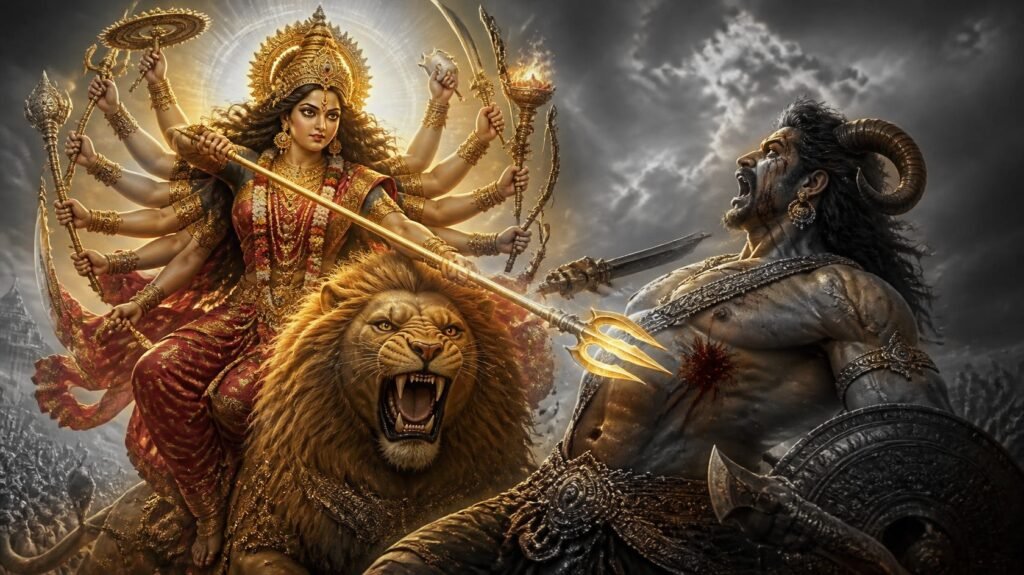
With Mahishasura’s defeat, the world was freed from his oppression, and the gods rejoiced. In remembrance of this victory, devotees worship Goddess Durga during the nine days of Navratri and celebrate Vijayadashami on the tenth day.
This story also makes Dussehra a festival that honours feminine power and celebrates the victory of righteousness over oppression and injustice.
2. The Story of Lord Rama’s Victory in the Ramayana
Another famous story associated with Dussehra comes from the Ramayana.
Ravana, the king of Lanka, abducted Mata Sita, the wife of Lord Rama. To rescue her, Lord Rama, with the help of the Vanara army, launched a campaign against Lanka.
During the great battle in Lanka, Lord Rama eventually defeated Ravana and freed Mata Sita. According to a widely followed Ramayana tradition, this victory is associated with the tenth day of the bright fortnight of Ashwin. It is remembered as a great triumph of righteousness over injustice, and Vijayadashami is celebrated in its honour.

To commemorate this event, Ramlila performances are organised in many parts of North India. Scenes from the Ramayana are enacted, and in the evening, effigies of Ravana, Kumbhakarna, and Meghnad are burned. Ravana Dahan events are also held in several places across Maharashtra.
Ravana is described in traditional accounts as a learned and powerful king. However, his arrogance and wrongful actions ultimately led to his downfall. The burning of his effigy therefore conveys a message about overcoming arrogance, rejecting injustice, and giving up harmful behaviour.
3. The Pandavas, the Shami Tree, and the Recovery of Their Weapons
The story of the Pandavas during their period of incognito exile in the Mahabharata is closely associated with the tradition of worshipping the Shami tree.
The Pandavas had to spend twelve years in exile, followed by one year in which they were required to live incognito. If their identities were discovered during that final year, they would have to undergo exile again.
To protect their identities, the Pandavas hid their weapons in a Shami tree, according to the well-known traditional story. After completing their incognito exile, Arjuna retrieved the weapons. He then confronted the Kaurava army, which had taken the cattle of King Virata’s kingdom, and drove them back.
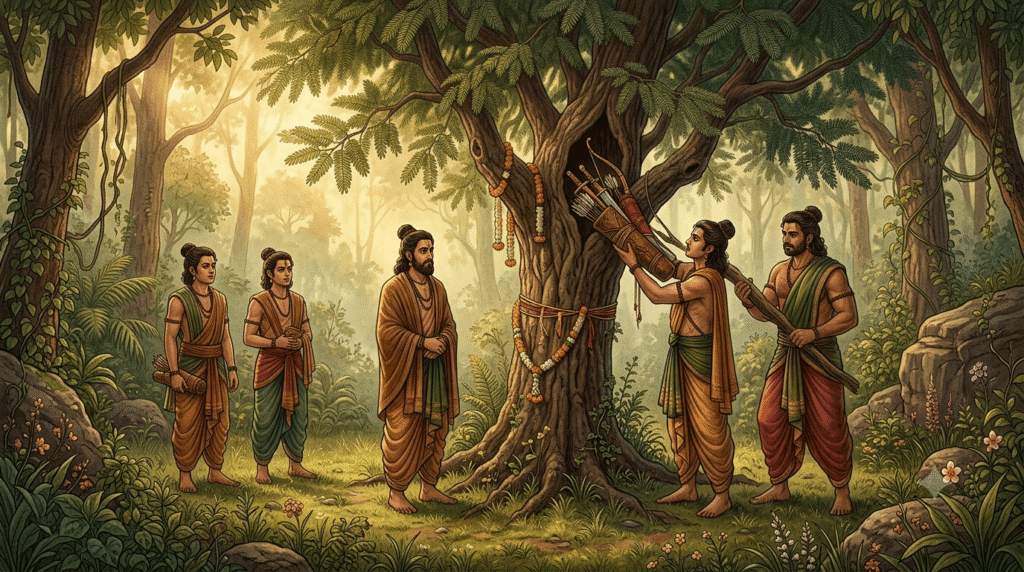
This episode gave the Shami tree special religious significance. The traditions of worshipping the Shami tree and honouring weapons on Dussehra are associated with this story.
In earlier times, kings and warriors worshipped their weapons before setting out for battle. Even today, some people observe the tradition of weapon worship on Dussehra and pray for victory, strength, and success.
4. The Story of King Raghu, Kautsa, and the Gold Coins
In Maharashtra, exchanging Apta leaves as symbolic gold on Dussehra is a particularly popular tradition. A story about King Raghu and Kautsa is traditionally associated with this custom.
Kautsa was a disciple of Sage Varatantu. After completing his education, he insisted on offering a guru dakshina, or a traditional gift of gratitude, to his teacher. According to a well-known version of the story, the sage asked him for fourteen crore gold coins.
To obtain such a large amount of wealth, Kautsa approached King Raghu. King Raghu was known for his generosity. However, after performing the Vishwajit Yajna and giving away his wealth in charity, he had very little left.
King Raghu was determined not to send Kautsa away empty-handed. He therefore resolved to obtain the wealth needed for the guru dakshina. One popular version of the story describes how he prepared to confront Kubera, the god of wealth, to obtain the required gold.
When Kubera learned of King Raghu’s determination and courage, gold coins are said to have rained down upon the Shami and Apta trees.
Kautsa took only the amount required for his guru dakshina. King Raghu distributed the remaining wealth among his subjects. According to this popular Maharashtrian tradition, exchanging Apta leaves as symbolic gold on Dussehra commemorates this event.
The main message of the story is generosity, respect for one’s teacher, and the importance of sharing wealth. The sequence of events, the number of gold coins, and other details may vary across different versions of the traditional account.
3. Are the Apta and Shami Trees the Same?
No. The Apta tree and the Shami tree are different plants.
In Maharashtra, people traditionally exchange the leaves of the Apta tree (Bauhinia racemosa) as symbolic gold on Dussehra. The Shami tree, on the other hand, holds special significance because of its association with mythological stories and the tradition of weapon worship.
The story of the Pandavas hiding their weapons in a Shami tree is associated with Shami worship. In the story of King Raghu and Kautsa, gold coins are said to have fallen upon Shami trees as well as Apta trees. These traditional stories have connected both trees with Dussehra.
Therefore, although exchanging Apta leaves and worshipping the Shami tree are both associated with Dussehra, they have distinct meanings and are not the same tradition.
4. What Rituals Are Performed on Dussehra?
In Maharashtra, families observe various religious and cultural rituals on Dussehra according to their customs and traditions.
Worship of the Goddess
In homes where the Navratri Kalash or Ghatasthapana ritual has been performed, devotees worship the Goddess on Vijayadashami. Flowers, offerings, and other items used in worship are presented to seek the blessings of the Goddess. In some households, this day marks the conclusion of their Navratri worship.
Weapon Worship
In earlier times, kings and warriors worshipped their weapons and prayed for victory before going into battle. This tradition is still followed in some places.
On this day, weapons are cleaned and worshipped. The underlying belief is that one’s strength should be used for righteous purposes.
Vehicle Worship
Many people worship their cars, motorcycles, and other vehicles on Dussehra. They clean their vehicles, decorate them with flowers, and pray for safety during their journeys.
Worship of Tools and Work Equipment
Farmers worship their ploughs and agricultural equipment, artisans honour their tools, and traders worship their account books. People in other professions also worship the tools and equipment they use in their daily work.
Today, some people include computers, laptops, books, and other useful devices in their worship. Expressing gratitude for the tools and resources that support our livelihood and everyday lives is an important part of this tradition.
Doorway Decorations with Marigold Flowers
On Dussehra, many people decorate the main entrance of their homes with garlands of marigold flowers and mango leaves. Some also decorate their shops and vehicles with flowers.
These decorations create a festive atmosphere and add to the joy of the celebration.
Exchanging Apta Leaves
On this day, people exchange Apta leaves with relatives, friends, neighbours, and acquaintances. Younger people offer the leaves to their elders and seek their blessings. While exchanging them, people affectionately say, “Accept this gold and may you live like gold.” In some places, people gather outside the village boundaries for Seemollanghan and then exchange Apta leaves.

Dussehra also brings together relatives and friends who may not have met for a long time. People exchange greetings, reconnect with one another, and strengthen their relationships. This makes the tradition socially meaningful as well as religiously significant.
5. What Is Seemollanghan? Why Is It Observed on Dussehra?
Seemollanghan literally means crossing a boundary.
In earlier times, kings, rulers, and military leaders would cross the boundaries of their kingdoms on Dussehra to begin new expeditions. As the monsoon season came to an end, conditions became more favourable for travel and military campaigns. This made the occasion particularly significant.
The tradition of Seemollanghan is still observed in many places across Maharashtra. In some villages, people travel beyond the village boundary and worship a Shami or Apta tree. They then exchange Apta leaves as symbolic gold.
In modern times, Seemollanghan can also be understood as an inspiration to move beyond our limitations and make progress. Setting new goals, beginning a worthwhile project, and making sincere efforts to overcome difficulties are all ways of putting the spirit of this festival into practice.
6. Why Is Dussehra Considered One of the Three-and-a-Half Auspicious Muhurats?
In Hindu tradition, the three-and-a-half auspicious muhurats hold special significance. These occasions are traditionally considered favourable for beginning new activities.
The commonly recognised three-and-a-half muhurats in Maharashtra are as follows:
- Chaitra Shukla Pratipada — Gudi Padwa: One full muhurat.
- Vaishakha Shukla Tritiya — Akshaya Tritiya: One full muhurat.
- Ashwin Shukla Dashami — Dussehra or Vijayadashami: One full muhurat.
- Kartik Shukla Pratipada — Diwali Padwa or Balipratipada: Half a muhurat.
Together, these four occasions are known as the three-and-a-half auspicious muhurats.
Since Dussehra is considered one of the full muhurats, many people prefer to begin a new business, purchase a home or vehicle, start a new project, or undertake an auspicious activity related to education on this day.
This is a religious and cultural tradition. For specific religious ceremonies or rituals, people generally consult the local Hindu calendar and follow the customs of their family or community.
7. Why Do People Buy Gold and Start New Ventures on Dussehra?
Dussehra is traditionally regarded as an auspicious day for new beginnings. For this reason, many people purchase gold, silver, new clothes, household items, electronic devices, or vehicles on this occasion.
Some people start new businesses, inaugurate shops, or purchase new tools and equipment for their work. These activities reflect the hope that new beginnings will bring progress and prosperity throughout the year.
8. How Is Dussehra Celebrated in Different Parts of India?
Dussehra and Vijayadashami are celebrated in different ways across India, depending on regional traditions and customs.
Maharashtra
In Maharashtra, exchanging Apta leaves as symbolic gold, observing Seemollanghan, worshipping weapons and vehicles, and seeking the blessings of elders are important traditions.
North India
In many parts of North India, Ramlila performances are organised during the festive period. Scenes from the Ramayana are enacted, and on Vijayadashami, effigies of Ravana, Kumbhakarna, and Meghnad are burned.
West Bengal
Durga Puja is celebrated with great enthusiasm in West Bengal. Vijayadashami marks the conclusion of the Durga Puja festivities and is associated with the immersion of Goddess Durga’s idols. In some places, the traditional Sindoor Khela ceremony, in which married women apply vermilion to one another, is also observed.
Karnataka
The Mysuru Dasara festival in Karnataka is particularly famous. It features decorated processions, cultural performances, and events associated with the region’s historic royal traditions.
Gujarat
In Gujarat, Garba and Dandiya Raas dances are important parts of the Navratri celebrations. Although Navratri and Vijayadashami are connected as part of the same festive period, the celebrations and their timing vary by region.
Across all these traditions, the spirit of devotion, joy, social harmony, and victory remains central to the celebration.
9. Frequently Asked Questions About Dussehra
Are Dussehra and Vijayadashami Different Festivals?
No. Dussehra and Vijayadashami are generally two names for the same festival. The name and the way it is celebrated may vary across regions.
On Which Day Is Dussehra Celebrated?
According to the Hindu calendar, Dussehra is celebrated on the tenth day of the bright fortnight of the month of Ashwin. The corresponding date in the Gregorian calendar changes every year.
Why Are Effigies of Ravana Burned on Dussehra?
According to the Ramayana, Lord Rama defeated Ravana and rescued Mata Sita. The burning of Ravana’s effigy in many parts of India commemorates this victory.
What Is the Difference Between Shami Worship and Exchanging Apta Leaves?
Exchanging Apta leaves as symbolic gold is a popular Maharashtrian tradition. Shami worship is associated with the mythological story of the Pandavas and their weapons, as well as other Vijayadashami rituals. The Apta and Shami are two different trees.
Is Dussehra One of the Three-and-a-Half Auspicious Muhurats?
Yes. According to the traditional list followed in Maharashtra, Vijayadashami is one of the three full auspicious muhurats.
What Do People Worship on Dussehra?
Depending on their family traditions, people may worship the Goddess, weapons, vehicles, agricultural equipment, work tools, books, account books, and other useful items.
Is Dussehra Considered Auspicious for Starting New Activities?
Yes. According to religious tradition, Vijayadashami is considered a favourable day for new beginnings. Many people start new activities on this occasion. However, success also depends on proper planning, hard work, and consistency.
The Message of Dussehra….
Dussehra, also known as Vijayadashami, is an important festival in Indian culture. The victory of Goddess Durga over Mahishasura, Lord Rama’s victory over Ravana, the Pandavas’ worship of the Shami tree, and the story of King Raghu and Kautsa give this festival its special religious and cultural significance.
Traditions such as exchanging Apta leaves as symbolic gold, observing Seemollanghan, worshipping weapons, and honouring the tools we use for our work express the faith, affection, and gratitude that are deeply rooted in Indian culture.
Dussehra also inspires us to make positive changes in our lives as we begin new activities. Treating others with kindness, avoiding arrogance, standing against injustice, and working honestly towards our goals are all consistent with the spirit of this festival.
When we exchange Apta leaves as symbolic gold, we wish one another happiness and prosperity. By nurturing love, trust, and goodwill in our relationships, we can make the joy of Dussehra even more meaningful.
Heartfelt wishes to everyone on Dussehra and Vijayadashami! May your life be filled with happiness, peace, prosperity, and success.
References:-
- Valmiki Ramayana
- Mahabharata
- Devi Mahatmya (Durga Saptashati)
- Traditional Dussehra and Vijayadashami customs in Maharashtra