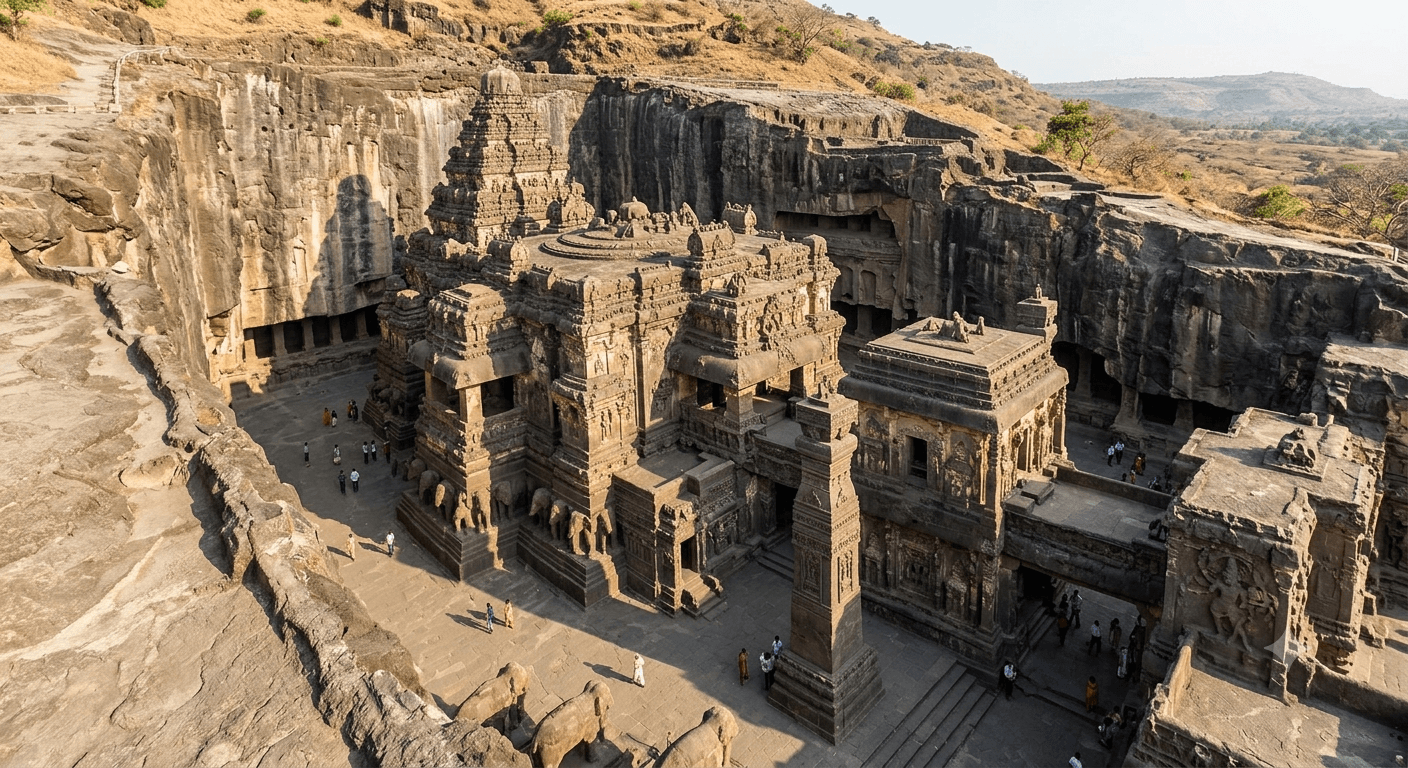
When we build a house or any other structure today, we usually start by preparing the foundation. Then come the walls, pillars, roof and other parts of the building.
But the Kailasa Temple at the Ellora Caves near Chhatrapati Sambhajinagar in Maharashtra was created in a completely different way.
This temple was not built by joining bricks, separate pieces of stone or modern construction materials. Instead, it was carved out of a massive block of basalt rock by removing stone from around and within it. Most importantly, the main excavation was carried out from the top downward.
Because of this unique method, Kailasa Temple is much more than a religious structure. It is a remarkable example of ancient Indian architecture, careful planning, craftsmanship and large-scale rock-cut engineering.
UNESCO also recognizes the Kailasa Temple as an exceptional example of monolithic architecture and an extraordinary technical achievement.
Table of Contents
- History and Historical Context: Who Built Kailasa Temple and When?
- Architecture and Structural Design
- The Engineering Marvel: The Top-Down Excavation Technique
- The Massive Rock Excavation — But How Much Stone Was Actually Removed?
- Scientific and Architectural Features
- Mysterious Stories, Underground Spaces and Hidden Passages
- Human Skill or Alien Technology?
- Why Is Kailasa Temple So Special?
- Conclusion: A Special Message from Jigyasa Manthan
1. History and Historical Context: Who Built Kailasa Temple and When?
The history of Kailasa Temple is as fascinating as its architecture.
The Rashtrakuta Dynasty and King Krishna I
The construction of Kailasa Temple is generally associated with Rashtrakuta king Krishna I, who ruled in the 8th century CE.
Archaeological and historical studies generally place the temple in the 8th century. However, there is no clear construction inscription on the monument that gives an exact starting and finishing date for the entire temple.
Therefore, rather than saying that the whole temple was definitely completed between 756 and 773 CE, it is more accurate to say that its creation is traditionally and historically associated with the reign of Krishna I.
During the Rashtrakuta period, stone architecture developed significantly in the Deccan. The Kailasa Temple at Ellora represents one of the most remarkable achievements of that architectural tradition.
The Religious Meaning Behind the Name ‘Kailasa’
The name Kailasa is connected with Mount Kailash, traditionally regarded as the abode of Lord Shiva.
The design of the temple reflects the symbolic idea of Mount Kailash. Many sculptures throughout the temple are associated with Shiva and stories from Hindu tradition.
One of the most famous sculptures depicts Ravana attempting to lift Mount Kailash. This dramatic sculpture is particularly noteworthy, and UNESCO also highlights it among the important artistic features of the monument.
Thus, the name ‘Kailasa’ is not simply related to the physical appearance of the temple. It is closely connected with its religious concept and the sacred association of Mount Kailash with Lord Shiva.
A Popular Marathi Legend: The Queen’s Vow and the Sculptor ‘Elu’
There is a well-known local legend associated with the Kailasa Temple.
According to the story, when the king became seriously ill, the queen prayed to Lord Shiva and made a vow that if the king recovered, she would observe a fast until she could see the temple’s shikhara.
As the construction of such a huge temple would normally take many years, the story says that a skilled sculptor named ‘Elu’ suggested beginning the work from the top of the structure.
This story should be understood as a part of local tradition rather than as a historically proven event.
However, the legend remains popular because it refers to one of the most distinctive features of the temple — its top-down excavation.
2. Architecture and Structural Design
Kailasa Temple is not simply an ordinary cave.
It is a massive independent temple complex carved out of a huge volume of rock.
The central temple, Nandi pavilion, entrance structures, halls, sanctum, sculpted walls and surrounding stone features were created by cutting and shaping the same large rock mass.
Different sources give slightly different measurements for the monument. Guinness World Records gives approximate dimensions of around 50 metres in length, 33 metres in width and about 30 metres in height.
Main Parts of the Temple
1. Entrance
The temple complex has a grand stone entrance leading into the main architectural area.
2. Nandi PavilionIn
front of the main temple is a separate stone pavilion dedicated to Nandi, the sacred bull associated with Lord Shiva.
3. Assembly Hall
The main temple contains a pillared hall decorated with a large number of intricate stone carvings.
4. Main Sanctum
At the centre of the temple is the sanctum dedicated to Lord Shiva. A passage for circumambulation is also provided around the sanctum.
Apart from these major elements, the walls, galleries and other parts of the temple contain numerous sculptures depicting Hindu deities, mythological episodes and various themes from Hindu religious traditions.
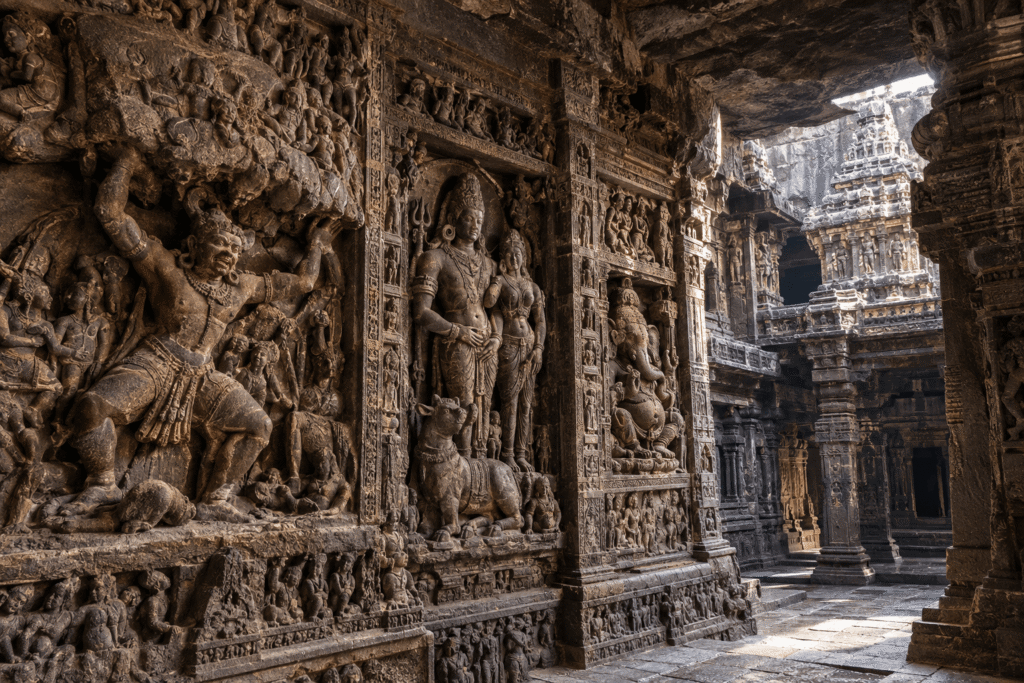
3. The Engineering Marvel: The Top-Down Excavation Technique
One of the most remarkable features of Kailasa Temple is the way it was created.
Conventional Construction
Foundation → Walls → Pillars → Roof → Shikhara
Kailasa Temple
Top of the rock → Excavation downward → Formation of the temple → Detailed carving
Kailasa Temple is an example of monolithic rock-cut architecture, meaning that the main structure was carved out of a single large rock mass.
Instead of constructing the temple by adding separate building materials, the surrounding rock was removed to isolate the main mass, which was then shaped into the temple.
UNESCO describes Kailasa as a monolithic temple and considers its excavation an extraordinary technical achievement.
The Need for Extremely Careful Planning
When a building is constructed using separate bricks or stones, mistakes in one section can sometimes be corrected by removing and rebuilding that portion.
Carving a temple directly out of solid rock is very different.
If a pillar was cut too deeply or a section of stone was removed by mistake, it could not simply be put back.
Therefore, the craftsmen had to carefully plan almost every major element — from the overall dimensions of the temple to the pillars, halls, sculptures and architectural details.
Today we have CAD software, 3D modelling and other digital technologies that help architects plan complex structures.
The craftsmen of that period obviously did not have such tools. Yet they used measurements, geometry, practical experience, traditional knowledge and a detailed understanding of the rock to create this enormous structure.
This makes the planning and execution of Kailasa Temple an important achievement in the history of architecture and engineering.
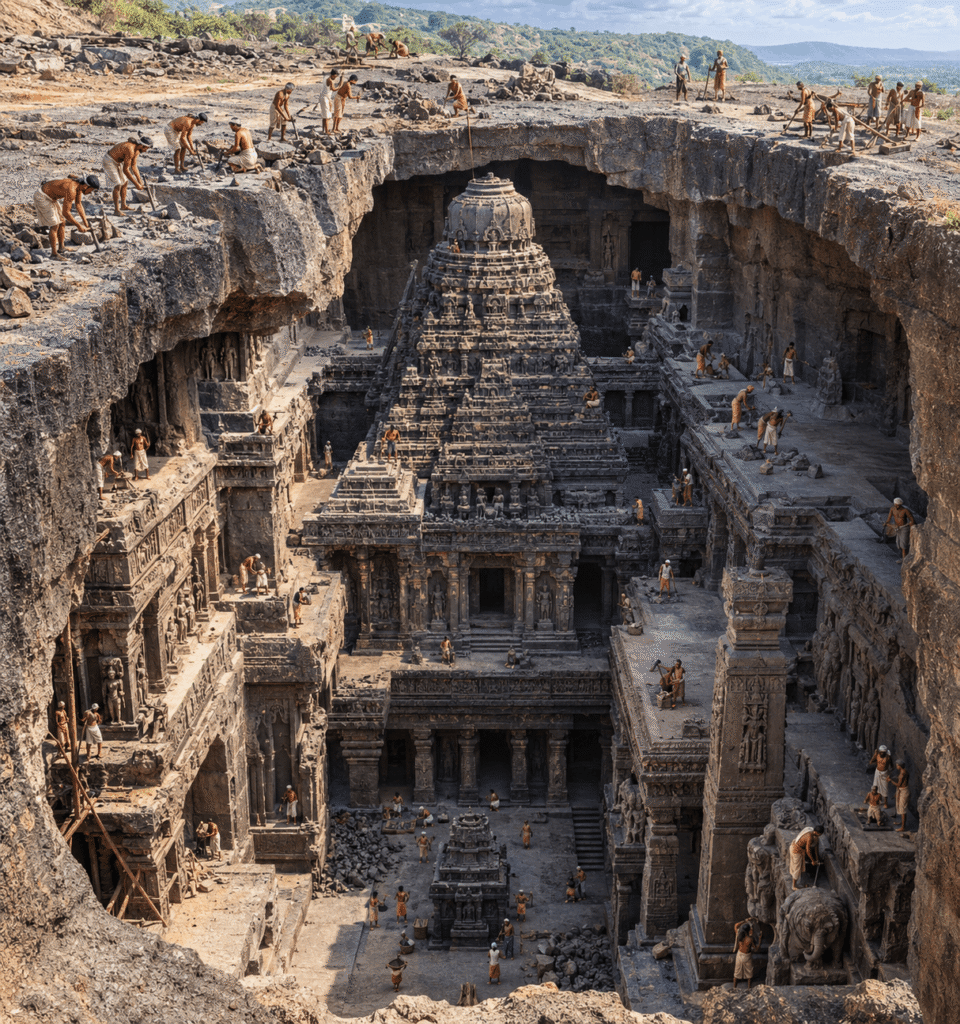
4. The Massive Rock Excavation — But How Much Stone Was Actually Removed?
There is no doubt that an enormous amount of basalt rock had to be removed to create Kailasa Temple.
Some studies and popular sources have suggested figures of around 150,000 to 200,000 tonnes or even more. Some popular articles have mentioned figures as high as 400,000 tonnes.
However, such figures are estimates based on the approximate volume of rock excavated. They are not measurements obtained by actually weighing the removed stone.
Therefore, it would not be accurate to state with certainty that exactly 400,000 tonnes of rock were removed.
Similarly, the popular claim that the entire temple was completed in exactly 18 years should also be treated with caution. There is no clear primary construction record that establishes 18 years as the definite completion period.
The important point is that, even though the exact amount of excavated rock and the precise construction period remain uncertain, the enormous scale of the rock excavation and the complexity of the finished temple are beyond doubt.
5. Scientific and Architectural Features
Kailasa Temple is remarkable not only because of its size, but also because of its planning, use of rock and overall spatial design.
1. Rainwater and Drainage
The Ellora region receives significant rainfall during the monsoon.
For a large rock-cut monument, managing rainwater would naturally have been an important consideration.
Various features associated with water flow and drainage can be seen in the architectural layout of the Kailasa complex, including stone channels and sloping surfaces that help direct water away.
It would not be appropriate to describe this simply as a modern-style ‘high-tech underground drainage system’. However, the attention given to water management in such an ancient rock-cut monument is certainly an interesting example of practical architectural planning.
2. Natural Light and Open Spaces
Kailasa Temple is not simply a completely enclosed cave.
A large part of the temple complex is open to the sky, allowing natural sunlight to reach different parts of the structure.
As the position of the sun changes, the relationship between light and shadow across the sculptures also changes.
This creates a striking visual effect and adds to the architectural beauty of the monument.
3. The Experience of Sound
The pillared halls, stone walls and enclosed architectural spaces can create a noticeable sense of resonance when sounds such as chanting or recitation are produced inside them.
It would be difficult to directly compare this with modern acoustic engineering without detailed scientific measurements.
Nevertheless, the way sound is experienced within these stone spaces adds another dimension to the atmosphere of the temple.
6. Mysterious Stories, Underground Spaces and Hidden Passages
Many mysterious stories and popular beliefs are associated with the Kailasa Temple.
While exploring the monument, visitors may notice different levels, stone passages, recessed areas and unusual architectural spaces. These features have sometimes led to various theories about hidden chambers or underground passages.
However, claims such as ‘there are secret tunnels beneath the temple’, ‘the Archaeological Survey of India has sealed them’ or ‘they were used to hide valuable objects’ should not be presented as established historical facts without reliable evidence.
Such stories are better understood as legends or popular theories rather than confirmed history.
7. Human Skill or Alien Technology?
After seeing the enormous scale and complexity of Kailasa Temple, some people naturally wonder:
How could people create something like this so many centuries ago?
This question has also given rise to a popular claim on the internet that the temple may have been created with the help of extraterrestrial or alien technology.
However, there is no reliable archaeological or scientific evidence supporting such a claim.
1. A Long Tradition of Rock-Cut Architecture
Ellora did not appear suddenly without any earlier tradition of stone carving.
India already had a long and rich history of excavating caves and creating rock-cut religious structures.
Ajanta, Bhaja, Karla, Elephanta and several other sites demonstrate this long architectural and sculptural tradition.
The Ellora complex itself developed over several centuries. According to UNESCO, the caves were created in different phases between approximately the 6th and 12th centuries CE and include Buddhist, Hindu and Jain monuments.
2. Kailasa Temple as a Remarkable Development of This Tradition
Seen in this broader context, Kailasa Temple can be understood not as a structure created through some unexplained technology, but as an extraordinary development of an already established tradition of rock-cut architecture and sculpture.
The scale and complexity of Kailasa are exceptional, but the techniques of working with rock had a much longer history.
3. There Is No Evidence for an Alien Theory
There is currently no reliable archaeological evidence showing that extraterrestrial technology was involved in the creation of Kailasa Temple.
Instead, the monument is clearly connected with Indian religious architecture, established rock-cut traditions and the use of the local basalt rock.
The real wonder of Kailasa Temple, therefore, lies not in an unexplained alien technology, but in the knowledge, planning, craftsmanship and hard work of the people who created it.
8. Why Is Kailasa Temple So Special?
The importance of Kailasa Temple goes far beyond its religious significance.
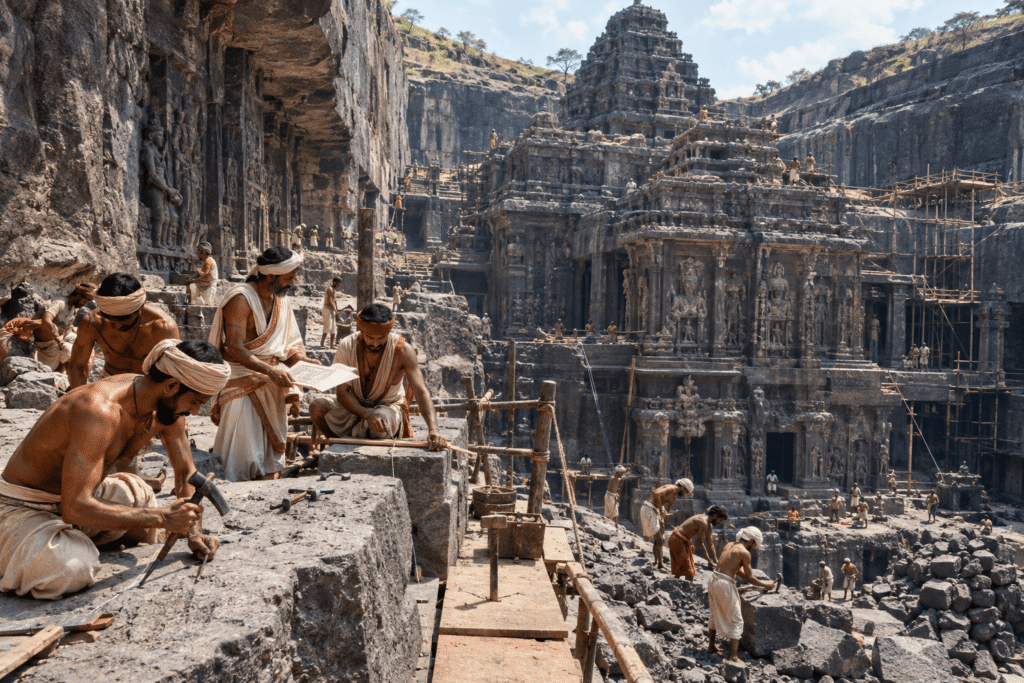
Creating an entire temple complex from a massive rock mass — including halls, a sanctum, Nandi pavilion, entrance structures, sculptures and numerous architectural details — required extraordinary planning, labour, skill and artistic ability.
UNESCO considers Ellora to be a site of exceptional artistic and technological importance, with the rock excavation of the Kailasa Temple being one of its most remarkable achievements.
For this reason, Kailasa Temple can be viewed not only as a religious monument, but also as a remarkable meeting point of faith, art, architecture, sculpture and human skill.
9. Conclusion: A Special Message from Jigyasa Manthan
The Kailasa Temple at Ellora is much more than a religious monument or a tourist attraction.
It is an extraordinary example of ancient Indian rock-cut architecture, sculpture, planning and craftsmanship — a monument that continues to amaze people even today.
Many legends and mystery stories have developed around the temple. Some belong to local traditions, while others have become popular through modern internet discussions.
But beyond all these stories, one fact remains clear:
Creating such a massive and complex structure out of a huge block of basalt required exceptional skill, careful planning, tremendous labour and remarkable creativity.
Kailasa Temple raises an interesting question:
“Even without modern machines, how much knowledge, practical experience, mathematical thinking and craftsmanship could people of the ancient world possess?”
Perhaps the greatest mystery of Kailasa Temple is not the search for some unknown technology, but the realization of what human beings of that time were capable of achieving through knowledge, skill, patience and hard work.
That may be the most fascinating story hidden within the stone of Kailasa.
References- UNESCO World Heritage Centre — Ellora Caves, Archaeological and architectural studies of Ellora and Kailasa Cave 16, Guinness World Records — Largest Monolithic Building
According to UNESCO, the Ellora Caves are managed by the Archaeological Survey of India (ASI) and the entire site is protected as a UNESCO World Heritage Site.