When we think about Indian culture, a vast and diverse cultural world comes to mind—deities, sages, kings, divine incarnations, sacred places, festivals, religious observances, and many traditions that have been followed through generations.
Many of the stories, religious ideas, and cultural traditions associated with these practices can be understood through the ancient Puranic tradition.
Even today, Puranas are read, recited, listened to, and discussed in many Indian households. From religious discourses in temples to kirtans, Harikatha, devotional gatherings, and other religious programmes, many stories from the Puranas continue to be narrated and heard with श्रद्धा and devotion.
But what exactly is a Purana?
How many Puranas are there? What is the difference between the Mahapuranas and the Upapuranas? What kinds of stories and descriptions are found in the Puranas? And why do some events appear in slightly different forms in different Puranas?
To understand all of this, it is important to first understand the meaning and nature of the Purana tradition.
Table of Contents
- What Is a Purana?
- When Were the Puranas Composed?
- What Is the Difference Between the Vedas and the Puranas?
- What Are the Eighteen Mahapuranas?
- What Are the Upapuranas?
- What Kind of Stories and Descriptions Are Found in the Puranas?
- The Place of the Puranas in Indian Culture
- Why Does the Same Story Sometimes Appear Differently in Different Puranas?
- Why Are the Puranas Still Important Today?
- The Importance of the Puranas
What Is a Purana?
The word ‘Purana’ is associated with the Sanskrit word ‘Pura’, which refers to something ancient, old, or belonging to an earlier time.
In simple words, the Puranas are an important body of ancient literature within the religious and cultural traditions of India. They contain descriptions of creation, cycles of time, deities, divine incarnations, sages, royal dynasties, religious duties, customs, sacred places, religious observances, charity, devotion, and many other religious and cultural subjects.
The stories found in the Puranas are not merely about individual characters or events. Many of them also convey ideas related to dharma, devotion, duty, karma, truth, self-control, sacrifice, and faith in the Divine.
Therefore, the Puranas can be understood not simply as ancient books, but as an important part of India’s religious and cultural heritage.
What Are the Five Main Characteristics of the Puranas?
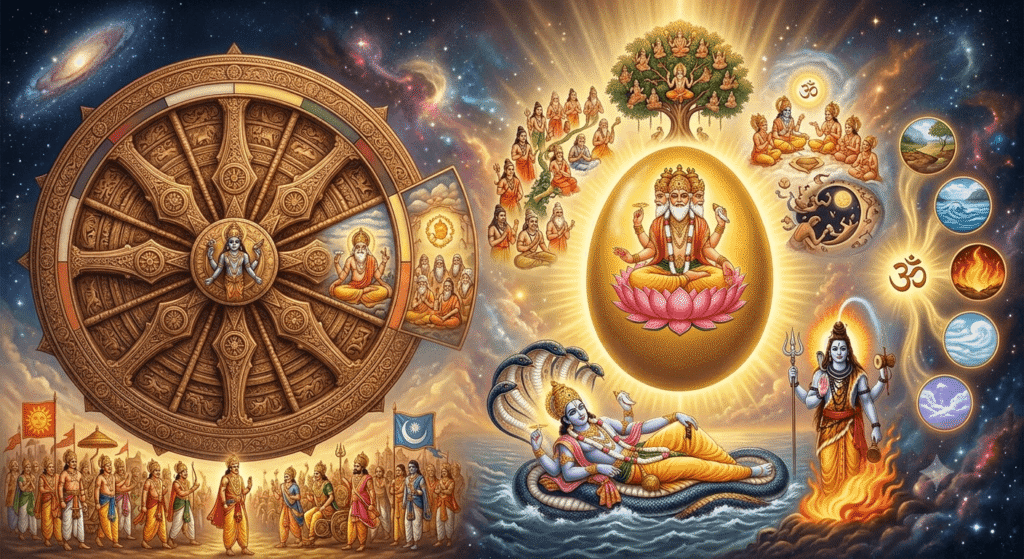
In the traditional understanding of Puranas, five major characteristics, known as Panchalakshana, are often mentioned.
These are:
1. Sarga
Sargarefers to the creation of the universe. Puranic texts contain descriptions concerning the origin of the universe and the creation of various forms of life.
2. Pratisarga
Pratisarga refers to the destruction or dissolution of creation and its subsequent recreation. It is connected with the idea of the recurring cycle of creation and dissolution.
3. Vamsha
Vamsha refers to the genealogies or lineages of gods, sages, and royal families described in the Puranic tradition.
4. Manvantara
According to Indian religious tradition, time is divided into different Manvantaras. The Puranas describe the Manus, deities, sages, and other events associated with these periods.
5. Vamshanucharita
Vamshanucharita refers to accounts of royal dynasties and the lives of important kings belonging to those lineages.
These five characteristics are useful for understanding the traditional nature of Puranic literature. However, not every Purana presents all five characteristics in exactly the same proportion. Some Puranic traditions also describe ten characteristics, rather than only five.
When Were the Puranas Composed?
The Puranic tradition has very ancient roots.
According to the traditional understanding, Maharishi Ved Vyasa is regarded as the compiler and organiser of the Puranic tradition.
However, when we look at the Puranic texts available today, it would be too simple to say that all of them were composed in one particular period and in a single form.
Modern scholarship suggests that the composition, expansion, rearrangement, and addition of different sections to various Puranic texts took place over a long period of time.
Therefore, the roots of the Puranic tradition are ancient, while the form of the texts available today reflects the development of religious and cultural traditions across different periods.
What Is the Difference Between the Vedas and the Puranas?
The Vedas and the Puranas are both highly important sources within Indian religious traditions, but their nature and presentation are different.
The Vedas contain mantras, hymns, sacrificial traditions, forms of worship, and various religious and philosophical ideas.
The Puranas, on the other hand, often present religious ideas through stories, dialogues, biographies, genealogies, sacred places, devotional traditions, and descriptions of religious practices.
In simple terms, the Vedas present fundamental religious and philosophical ideas in their own distinctive form, while the Puranic tradition often explains and presents many religious ideas through stories and detailed narratives.Both have their own distinct place and importance in Indian religious traditions.
What Are the Eighteen Mahapuranas?
The tradition of Hindu Puranic literature is commonly associated with eighteen Mahapuranas.
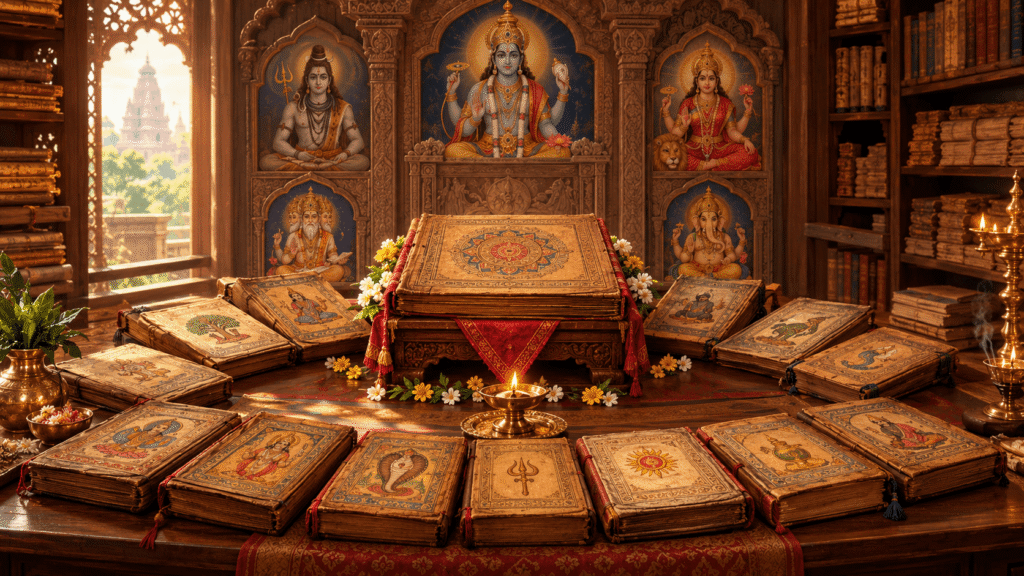
The eighteen generally mentioned are:
1. Brahma Purana
2. Padma Purana
3. Vishnu Purana
4. Shiva Purana
5. Shrimad Bhagavata Purana
6. Narada Purana
7. Markandeya Purana
8. Agni Purana
9. Bhavishya Purana
10. Brahma Vaivarta Purana
11. Linga Purana
12. Varaha Purana
13. Skanda Purana
14. Vamana Purana
15. Kurma Purana
16. Matsya Purana
17. Garuda Purana
18. Brahmanda Purana
Each Purana has its own character, subject matter, style of presentation, and religious significance.
For example, some Puranas give particular importance to Vishnu and his incarnations, while others give greater importance to Shiva, Devi, or other religious traditions.
It is also worth noting that in some ancient traditions, Vayu Purana appears in the list in place of Shiva Purana. Therefore, small differences can be found in traditional lists of the eighteen Puranas. This is one reason why the traditional context of a particular list is important when studying the Puranas.
What Are the Upapuranas?
Along with the Mahapuranas, the Indian tradition also refers to Upapuranas, or secondary Puranic texts.
Traditionally, eighteen Upapuranas are also mentioned. However, their names and classification may vary to some extent across different textual traditions.
The Upapuranas also contain accounts related to various deities, sacred places, religious observances, devotional practices, and particular religious traditions.
Together, the Mahapuranas and Upapuranas form a vast and diverse part of India’s Puranic literary tradition.
What Kind of Stories and Descriptions Are Found in the Puranas?
The subject matter of the Puranas is not limited to one particular type of story.They contain a wide range of narratives and descriptions connected with India’s religious and cultural life.
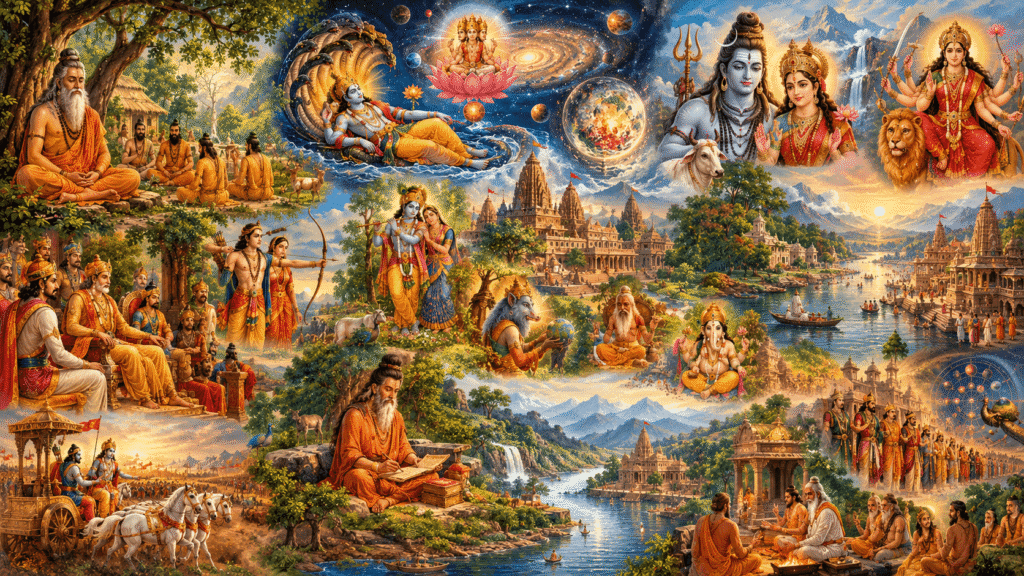
1. Stories Related to Gods and Goddesses
Many Puranas contain stories, teachings, devotional traditions, and accounts of the glory of deities such as Vishnu, Shiva, Devi, Brahma, Ganesha, and Surya, along with many other divine forms.
These accounts reflect the religious traditions and devotional feelings associated with different deities.
2. Accounts of Divine Incarnations
Divine incarnations hold an important place in Indian religious traditions.
Various Puranas contain accounts related to the incarnations of Lord Vishnu, including Matsya, Kurma, Varaha, Narasimha, Vamana, Parashurama, Rama, Krishna, and others.
The major traditions associated with the lives of Lord Rama and Lord Krishna are closely connected with the Ramayana and the Mahabharata as well. At the same time, many episodes associated with their lives and their religious significance are also described in detail in various Puranic texts.
3. Sages, Their Knowledge and Their Spiritual Practices
The Puranas contain accounts of many sages and seers belonging to Indian religious traditions.
Their lives, spiritual practices, knowledge, devotion, and dedication to the Divine are described through various narratives.
Many such stories highlight the importance of discipline, devotion, self-control, spiritual practice, and faith.
4. Kings and Royal Dynasties
Many Puranas describe kings, royal families, and their genealogies.
The lives of certain kings are presented through ideas such as dharma, duty, charity, sacrifice, and responsibility towards their people.
Through such narratives, the Puranas also preserve memories and traditions associated with different royal lineages.
5. Creation, Cycles of Time and Dissolution
The Puranic tradition contains extensive discussions about the creation of the universe, different periods of time, Yugas, Manvantaras, and Pralaya.
These descriptions are important for understanding the traditional Indian concept of cyclical time.
The Place of the Puranas in Indian Culture
The influence of the Puranic tradition can be seen in many aspects of Indian culture.
Religious programmes in temples, religious observances, the importance associated with sacred places, festivals, kirtans, discourses, Harikatha, devotional singing, and religious reading traditions often contain stories and ideas associated with the Puranas.
Their influence can also be seen in Indian art and culture.
Paintings, sculptures, classical and traditional forms of dance, theatre, folk art, and temple architecture contain many scenes, symbols, and themes associated with Puranic traditions.
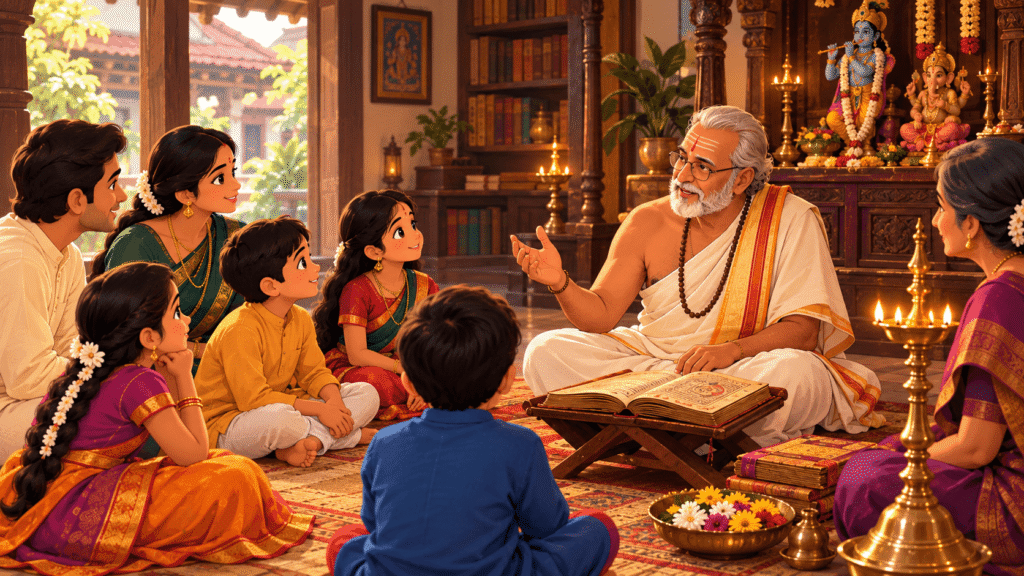
In many families, elders continue to narrate religious stories and traditional episodes to younger generations.
Through such storytelling, it is not only the stories that are passed down. The faith, values, cultural traditions, and sense of connection associated with them are also carried forward from one generation to another.
Why Does the Same Story Sometimes Appear Differently in Different Puranas?
One interesting aspect of studying the Puranas is that the same event may sometimes be described in slightly different ways in different texts.
There are several reasons for this.
The Puranic tradition developed over a long period of time and was preserved across different regions and religious traditions.
Some Puranas give particular importance to Vishnu and Vaishnava traditions, while others give greater importance to Shiva, Devi, or other traditions.
As a result, certain details of a particular story may be presented differently according to the religious perspective and purpose of the text.
This does not necessarily mean that one account simply rejects another. The diversity within the Puranic tradition can be better understood when each account is studied in the context of the particular text and tradition in which it appears.
Why Are the Puranas Still Important Today?
Life today has changed greatly, yet many religious and cultural traditions in Indian society continue to have deep connections with ancient traditions.
The ways in which festivals are celebrated, religious programmes are conducted in temples, religious observances are followed, pilgrimages are undertaken, and spiritual discourses are organised often reflect elements of the Puranic tradition.
The importance of the Puranas, therefore, does not lie only in their antiquity.
They also help us understand how Indian society preserved and passed on ideas of dharma, devotion, culture, values, and religious traditions across generations.
For many people, the Puranas remain a living part of their cultural and spiritual heritage.
The Importance of the Puranas
The Puranas form a vast and diverse body of literature within India’s religious and cultural traditions.
They contain stories and descriptions related to gods and goddesses, divine incarnations, sages, royal dynasties, creation, cycles of time, sacred places, religious observances, devotion, dharma, and various values associated with life.
Through the eighteen Mahapuranas and numerous Upapuranic traditions, many religious ideas, stories, cultural memories, and traditions have been passed from one generation to another.
Although each Purana has its own subject matter, perspective, and style of presentation, all of them form an important part of the broader Puranic heritage of India.
The place of the Puranas in Indian culture is not limited to that of ancient texts. They are deeply connected with faith, tradition, cultural identity, and religious life.
That is why even today, listening to or reading stories from the Puranas can create a sense of devotion, familiarity, and connection with one’s cultural heritage.
Perhaps this is also why curiosity about the Puranas continues to remain alive.
Within this vast tradition, we can see many aspects of Indian religious and cultural life coming together—faith, dharma, devotion, thought, customs, values, and a distinctive way of understanding life.
References :-
- UCLA South Asia Studies – The Puranas
- Classical Hindu Mythology: A Reader in the Sanskrit Puranas – Cornelia Dimmitt & J. A. B. van Buitenen