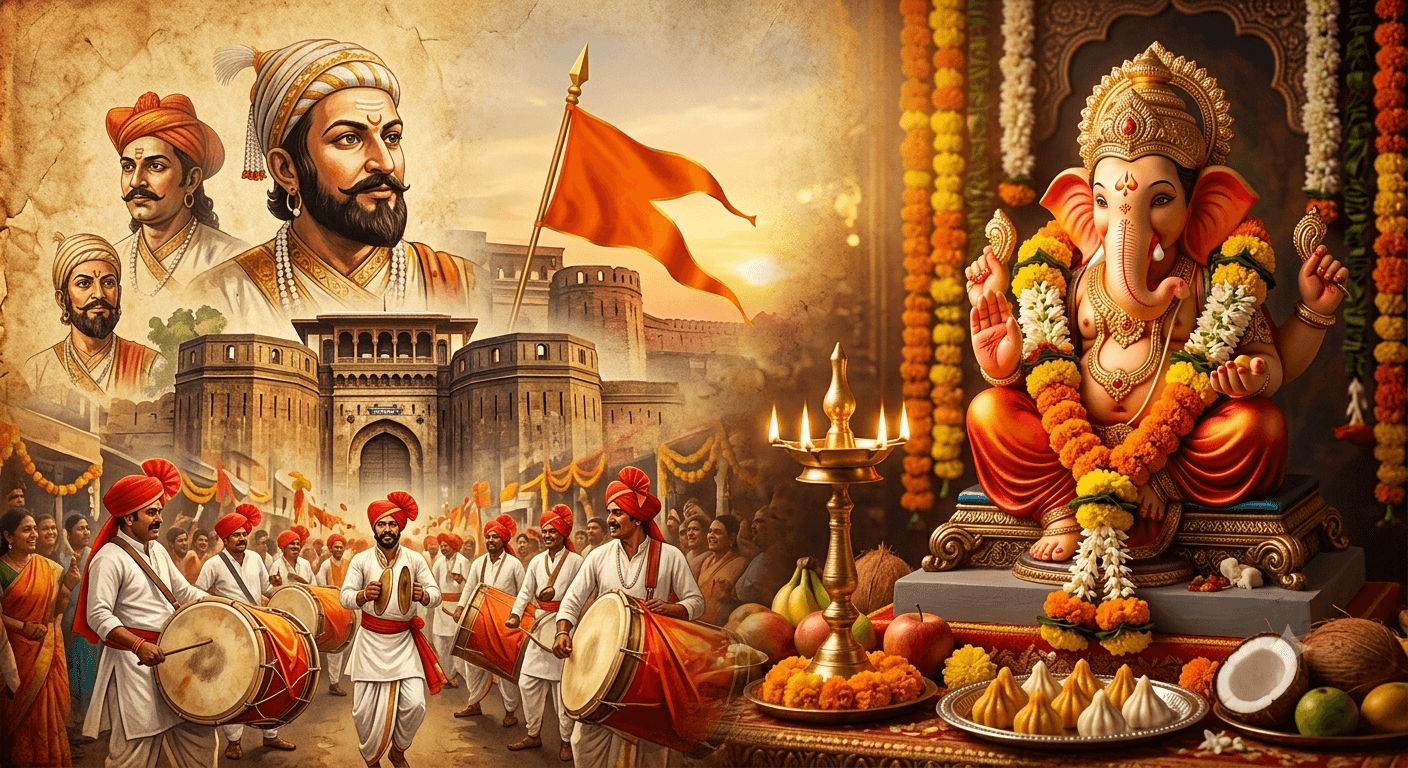
As the month of Bhadrapada arrives, a different kind of excitement can be felt everywhere. In homes, streets and neighborhoods, one name starts echoing everywhere—
“Ganpati Bappa Morya!”
For us, Ganeshotsav is not just a festival. It is an emotion, a time to celebrate with family and a beautiful occasion that brings people closer to one another.
But have you ever wondered how our beloved Bappa came out of the home shrine and became a part of public celebrations in streets and neighborhoods? How did this tradition begin, and how did it gradually take the grand form we see today?
Let us understand the journey of Ganeshotsav in simple language, step by step.
Table of Contents
- The Ancient Tradition of Lord Ganesh Worship
- From the Time of Chhatrapati Shivaji Maharaj to the Peshwas — Ganeshotsav Receives Royal Support
- 1892 to 1894 — Public Ganeshotsav Gets a New Direction
- What Was Ganeshotsav Like in the Early Days?
- Why Did Ganeshotsav Become So Big in Maharashtra?
- Times Changed, and Ganeshotsav Changed Too
- From Bappa at Home to Bappa in the Community
1. The Ancient Tradition of Lord Ganesh Worship
The tradition of worshipping Lord Ganesha is not new. It has a history going back many centuries. In ancient religious and literary traditions, Ganesha has been given special importance as the remover of obstacles, the deity of wisdom and a god associated with the beginning of auspicious activities.
The tradition of worshipping Ganesha on Bhadrapada Shukla Chaturthi, commonly known as Ganesh Chaturthi, has also been followed for a very long time.
However, the ten-day grand public Ganeshotsav that we see today did not exist in the same form in those times. Ganesh Chaturthi was mainly celebrated as a religious and family festival. Families would bring a Ganesha idol into their homes, perform prayers and rituals, and celebrate the festival according to their traditions.
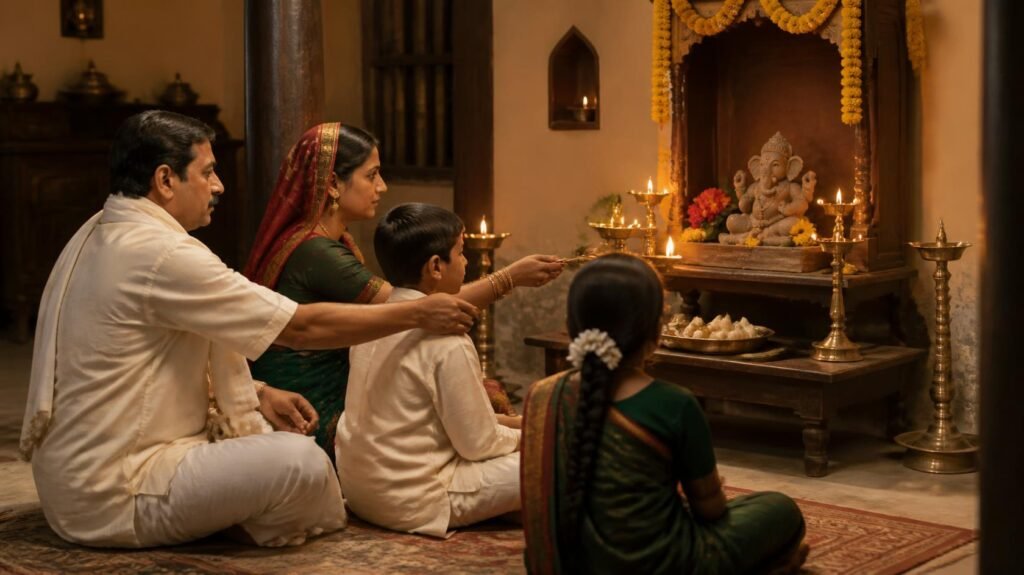
Making an idol from clay, worshipping it and later immersing it in water is also seen as a beautiful tradition connected with nature. The idea of a clay idol returning to nature reflects the deeper meaning behind this tradition. This is also why traditional clay idols are often discussed when people talk about an environment-friendly Ganeshotsav today.
So, while the tradition of worshipping Ganesha is very old, today’s public Ganeshotsav developed through several different stages of history.
2. From the Time of Chhatrapati Shivaji Maharaj to the Peshwas — Ganeshotsav Receives Royal Support
In the history of Maharashtra, Ganesh worship later received royal support as well.
Kasba Ganpati in Pune is traditionally regarded as the Gramdevata, or guardian deity, of Pune. It has held an important place in the city’s religious and cultural life.
The tradition of Kasba Ganpati is associated with Jijabai and the time of Chhatrapati Shivaji Maharaj. Over the years, its importance in Pune’s social and cultural life continued to grow.
Later, during the 18th century, Ganeshotsav received special importance under the rule of the Peshwas. Lord Ganesha was considered the family deity of the Peshwas. Because of this, Ganeshotsav was celebrated with great enthusiasm and grandeur in the Peshwa court at Pune.
Along with prayers and religious rituals, events such as kirtans, music, cultural programmes and community meals were also organised.
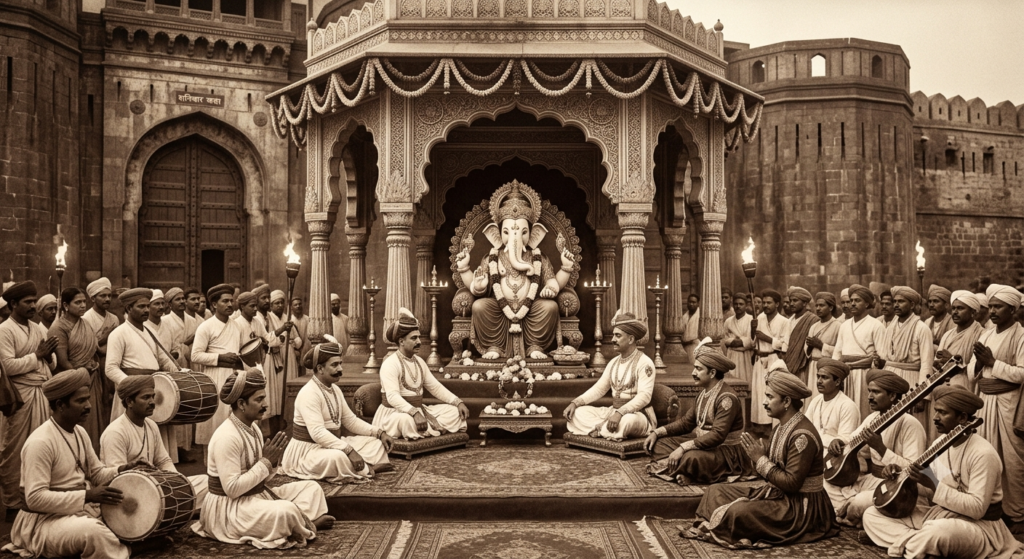
The Shaniwar Wada was the main centre of Peshwa power at that time. As a result, Ganeshotsav became closely connected with the culture and traditions of Pune during the Peshwa period.
However, in 1818, Peshwa rule came to an end. With this, the royal support that Ganeshotsav had received also came to an end.For some time after that, the public and political importance of the festival became less visible, and Ganeshotsav was once again mainly celebrated in homes and families.
3. 1892 to 1894 — Public Ganeshotsav Gets a New Direction
So, how did a festival mainly celebrated in homes become a public celebration once again?
The answer is connected not only with religion and tradition but also with the social and political conditions of the late 19th century.
During British rule, there were restrictions on large public gatherings and political activities by Indians. In such a situation, religious and cultural events could become an effective way for people to come together.
Bhau Rangari’s Effort — 1892
In the history of public Ganeshotsav, the name of Bhausaheb Laxman Javale, popularly known as Bhau Rangari, is very important.In 1892, Bhau Rangari and his associates organised a public Ganeshotsav in Pune.
His Ganesha idol was different from the usual idols. It showed Lord Ganesha killing a demon. The idol was made using materials such as wood and papier-mâché.
In later historical accounts, this image has also been viewed as a symbol of resistance against British rule.
However, there are different views about who actually started the public Ganeshotsav.
Some historical records and documents connected with the Bhau Rangari institution consider his efforts in 1892 an important early stage in the development of public Ganeshotsav. At the same time, some accounts mention Krishnaji Pant Khassgiwale, who is said to have seen a public Ganesh festival in Gwalior and brought the idea to Pune.
Therefore, it is more appropriate to say that Bhau Rangari was one of the key early figures in the development of public Ganeshotsav, while several other people later played important roles in taking the movement forward.
Lokmanya Tilak’s Vision
Around the same period, Lokmanya Bal Gangadhar Tilak recognised the social and public power of Ganeshotsav.
In 1893, Tilak supported the efforts to organise public Ganeshotsav through Kesari. He later played an important role in giving the festival a more organised and wider public form.
Tilak understood that a festival connected with religion and culture could bring people from different sections of society together.
During Ganeshotsav, programmes such as kirtans, speeches, powadas, fairs, plays and activities promoting national awareness began to be organised.
Through these programmes, efforts were made to spread social awareness, unity and a sense of belonging towards the country.
Slowly, public Ganeshotsav began spreading beyond Pune as well.
In this way, the public Ganeshotsav we know today developed through the efforts of early organisers such as Bhau Rangari and the wider direction later given to the movement by Lokmanya Tilak.
4. What Was Ganeshotsav Like in the Early Days?
Today, it is difficult to imagine Ganeshotsav without large mandaps, colourful lights, sound systems and beautiful decorations.
But the atmosphere of the early public Ganeshotsav was quite different.
The Idols
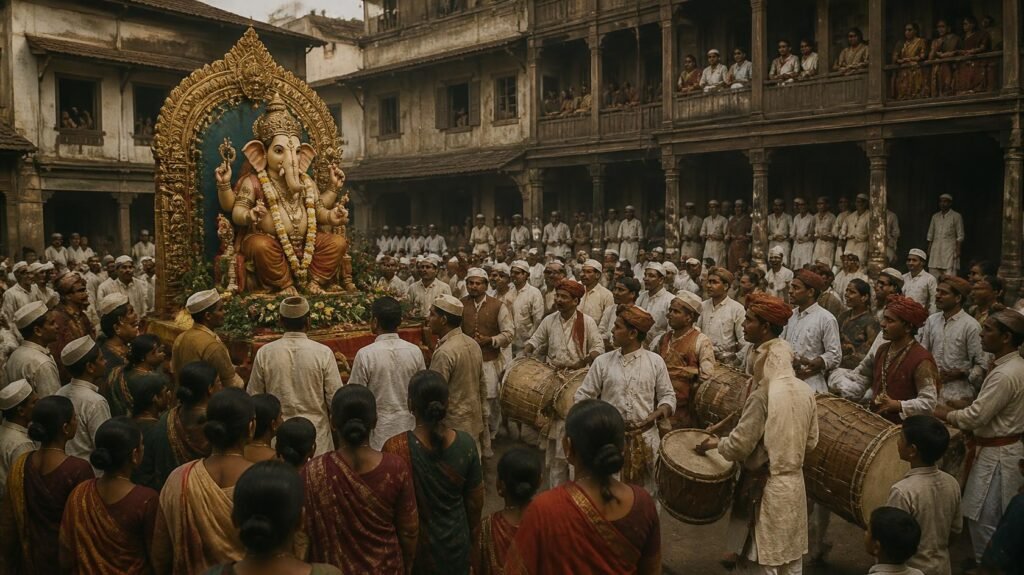
At that time, idols were mainly made from clay, papier-mâché and other locally available natural materials. Very large idols like those commonly seen today were not usual.
Traditional Instruments and Processions
Traditional instruments such as dhol, tasha, jhanj, shehnai and lezim were an important part of the celebrations.
Processions held while bringing the idol for installation and during immersion also became an important part of the festival.
Social Awareness
Public Ganeshotsav included fairs, powadas, kirtans, plays and speeches.
These programmes were used to spread messages of social awareness, unity and national consciousness.
In this way, public Ganeshotsav gradually became more than a religious celebration. It became a social and cultural platform where people could come together.
5. Why Did Ganeshotsav Become So Big in Maharashtra?
The worship of Ganesha is not limited to Maharashtra. Different parts of India have their own traditions of Ganesha worship. Ganesha is also respected in different religious and cultural traditions outside India.
However, the grand ten-day public Ganeshotsav became especially connected with the social and cultural life of Maharashtra.
There were several historical reasons behind this.
The importance given to Ganesha worship during the Peshwa period in Pune, the development of public Ganeshotsav and the wider direction given to it by Lokmanya Tilak in the late 19th century all played a role.
The tradition of public celebration gradually spread from Pune to different cities and villages across Maharashtra.
This is why public Ganeshotsav has become an important part of Maharashtra’s cultural identity today.
6. Times Changed, and Ganeshotsav Changed Too
With time, the form of Ganeshotsav also changed greatly.
Today, large mandaps are decorated in streets and neighborhoods. Beautiful lights are used, and Ganesha idols are installed with great enthusiasm.
Young people actively take part in dhol-tasha groups, often with great energy and discipline.
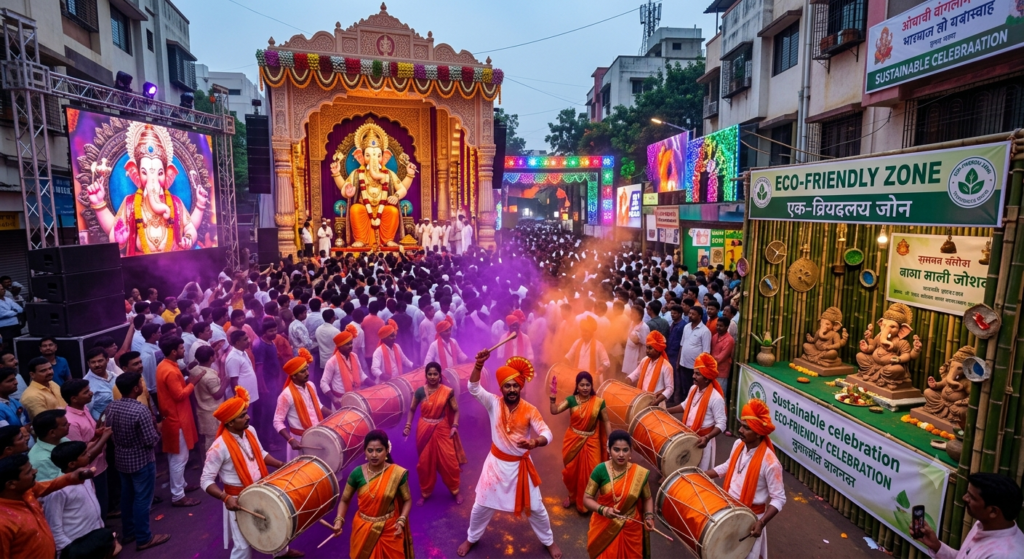
Many Ganesh mandals now include social work along with cultural programmes.
Blood donation camps, educational materials for students in need, health-related activities, support for patients and other social initiatives are becoming part of Ganeshotsav.
Interestingly, today’s celebrations are also showing a return to some of the festival’s older roots.
To reduce harm to the environment, many people are choosing clay idols, natural colours and eco-friendly decorations.
In other words, the form of Ganeshotsav continues to change, but the feelings behind it—devotion, togetherness and connection with society—remain the same.
7. From Bappa at Home to Bappa in the Community
When we look at the history of Ganeshotsav, its journey is truly special.
On one side, there is the centuries-old tradition of worshipping Lord Ganesha. Then came the royal support given during the Peshwa period. After that, the tradition continued in homes and families even as times changed.
Then, in the 1890s, the efforts of Bhau Rangari, Krishnaji Pant Khassgiwale, Lokmanya Tilak and many others helped give the festival a new public form.
All these different stages together shaped the Ganeshotsav we know today.
That is why Ganeshotsav is no longer just a religious festival. It has become an important part of the history, culture and social life of Maharashtra.
On Anant Chaturdashi, when the time comes to bid farewell to Bappa, the eyes of young and old alike often become emotional.
The lively atmosphere that filled homes and streets for ten days slowly becomes quiet.
Yet, even while saying goodbye to Bappa, there is always hope in the heart
“Ganpati Bappa Morya, come back soon next year!”
Ganeshotsav teaches us not only devotion but also the importance of staying together, helping one another and remaining positive in life.
Perhaps that is why this festival has continued to hold a special place in people’s hearts and homes for centuries. Its form may have changed with time, but its place in our lives remains just as special.
Wishing you and your family a very Happy Ganesh Chaturthi! 🙏
May the remover of obstacles, Lord Ganesha, remove all the difficulties and obstacles from your life. May your life always be filled with happiness, prosperity, good health and joy.
Happy Ganesh Chaturthi!… 🙏
Ganpati Bappa Morya!…
Mangalmurti Morya!…