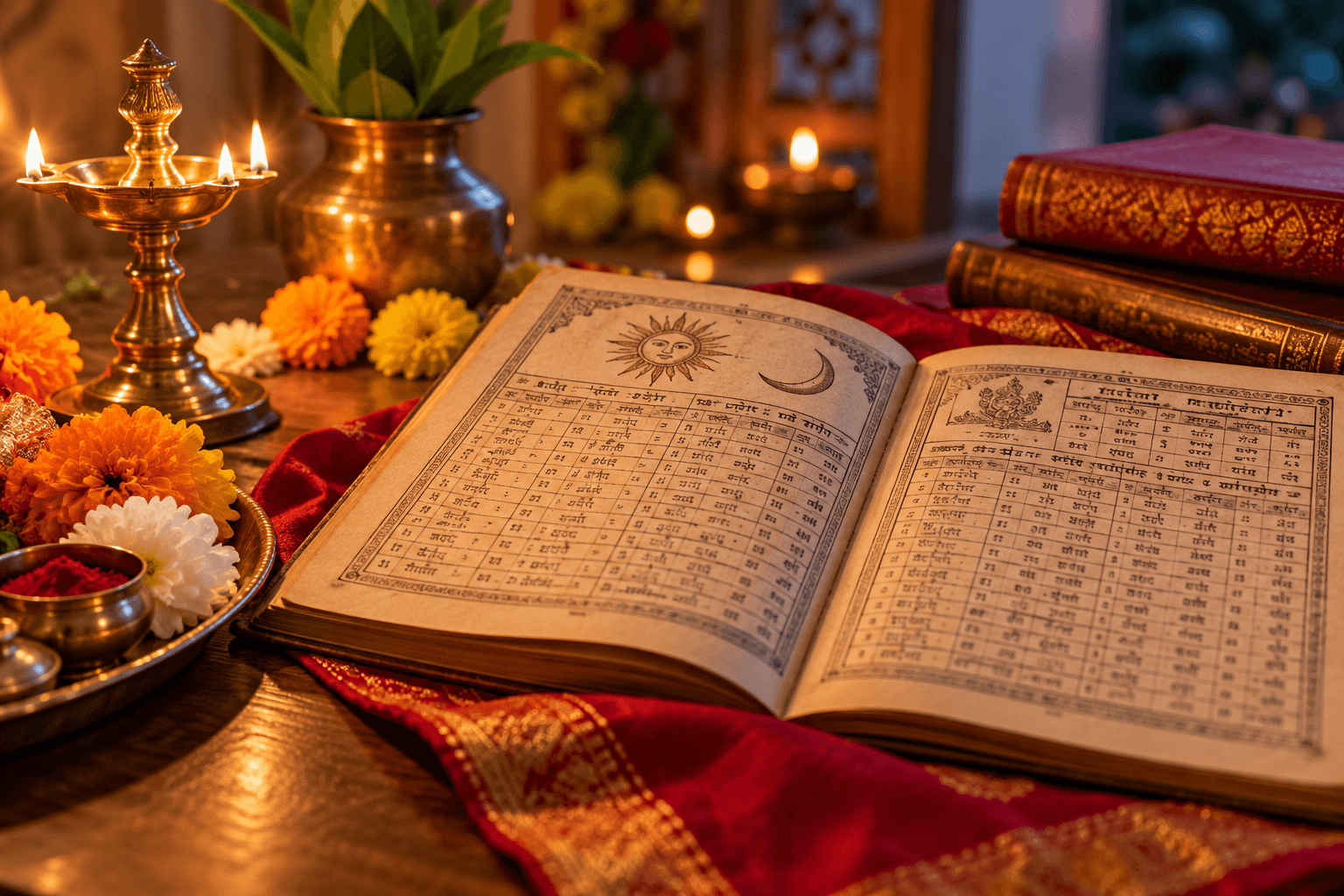
Whenever Diwali approaches, there is a special kind of excitement at home. Preparations begin with cleaning, shopping, making sweets and planning the celebrations. But when it comes to deciding the exact date and time for Lakshmi Puja, someone in the family is almost certain to say, “Let’s check the Panchang first!”
The same thing happens before Gudi Padwa, Ganesh Chaturthi and many other festivals. Whether it is a religious ceremony, a fast or an auspicious occasion, the Panchang continues to play an important role in many Indian households.
But have you ever wondered why?
We have calendars on our walls and dates on our mobile phones. We can easily find out which day it is and when the next festival falls. So why do people still turn to the Panchang? What information does it provide that an ordinary calendar cannot?
The answer is quite interesting. A Panchang is much more than a calendar of festivals and religious occasions. It is a traditional system of timekeeping based on the movements and positions of the Sun and the Moon. Behind its calculations are astronomy, mathematics and centuries of observation of the sky.
To understand how it works, let’s take a closer look at the Panchang and the five elements that make it what it is.
Table of Contents
- What Exactly Is a Panchang?
- What Is a Tithi? How Is It Different from an English Calendar Date?
- We Already Know the Weekdays, So Why Are They Part of the Panchang?
- What Is a Nakshatra? Understanding the Moon’s Journey Across the Sky
- The Yoga in a Panchang Is Not the Yoga We Practise!
- What Is a Karana? Understanding Half of a Tithi
- How Is the Panchang Useful in Everyday Life?
- Why Do Different Panchangs Sometimes Show Different Dates for the Same Festival?
- Where Can You Learn More About the Panchang?
1. What Exactly Is a Panchang?
The word Panchang comes from two Sanskrit words: Pancha, meaning five, and Anga, meaning parts or components. As the name suggests, a Panchang is based on five important elements that help describe the position and movement of celestial bodies and the passage of time.
These five elements are:
- Tithi – Lunar day
- Vara – Weekday
- Nakshatra – Lunar mansion
- Yoga – A particular combination of the Sun’s and Moon’s positions
- Karana – Half of a Tithi
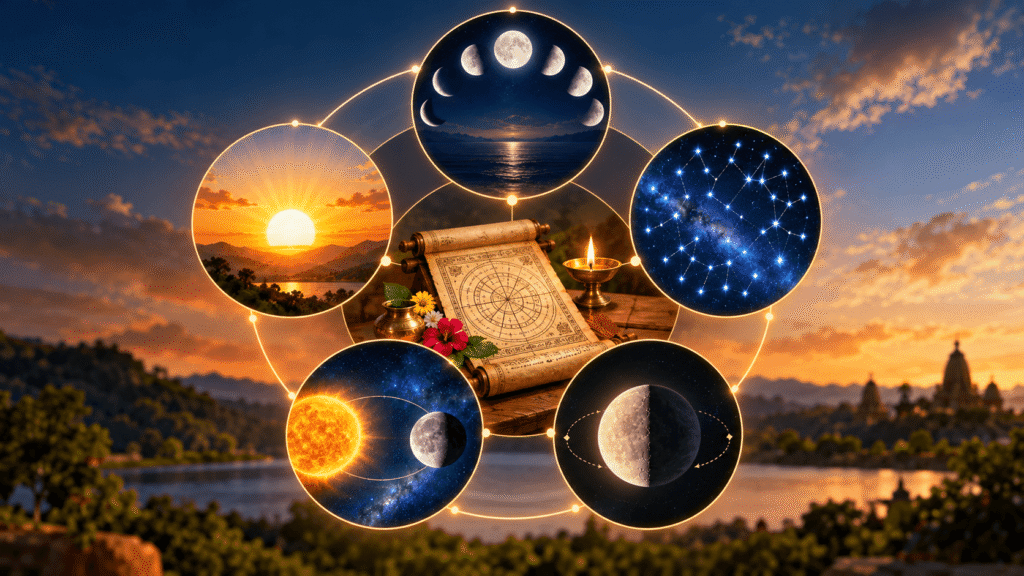
You may have come across these names while reading a traditional calendar or listening to elders discuss an upcoming festival. Although they sound familiar, their actual meanings are not always clear.
A Panchang also provides other useful astronomical information, including sunrise, sunset, moonrise and moonset timings. The National Panchang published by the India Meteorological Department (IMD), Government of India, contains such information along with details of the traditional elements of timekeeping.
This makes the Panchang an interesting combination of astronomical calculations and India’s traditional calendar system.
Let’s begin with Tithi, because it is one of the most important elements when it comes to understanding Indian festivals.
2. What Is a Tithi? How Is It Different from an English Calendar Date?
Think about the calendar we use every day. If today is the 10th of a month, tomorrow will be the 11th and the following day will be the 12th. The dates follow a fixed sequence, and each new date begins at midnight.
A Tithi follows a different method of calculation.
In the Panchang, a Tithi is determined by the angular distance between the Sun and the Moon as seen from Earth. Whenever this angular distance increases by 12 degrees, a new Tithi begins.
This may sound complicated at first, but observing the Moon makes the idea much easier to understand.
Look at the Moon over several nights. Around Amavasya (New Moon), it is generally not visible in the night sky. After that, a thin crescent gradually appears and grows brighter each night. By the time Purnima (Full Moon) arrives, the Moon appears fully illuminated. Its visible illuminated portion then begins to decrease until Amavasya comes around again.
This changing relationship between the Sun and the Moon forms the basis of the lunar fortnight.
The period from Amavasya to Purnima is called Shukla Paksha, while the period from Purnima to the next Amavasya is known as Krishna Paksha. During these two periods, Tithis such as Pratipada, Dwitiya, Tritiya and the remaining lunar days follow one another.
There is one important difference between a Tithi and an ordinary calendar date. A Gregorian calendar date changes at midnight, but a Tithi changes according to the relative positions of the Sun and the Moon. It can begin or end at any time of the day or night.
For example, a Tithi might begin on Monday afternoon and end on Tuesday morning. In that case, the same Tithi extends across two calendar dates. Sometimes, it may begin and end between two sunrises, which means it will not be the Tithi prevailing at sunrise on either of those days.
This is also one of the reasons why the dates of festivals such as Diwali, Gudi Padwa and Ganesh Chaturthi do not remain the same in the Gregorian calendar every year. Their dates are linked to particular Tithis and traditional festival rules rather than fixed calendar dates.
3. We Already Know the Weekdays, So Why Are They Part of the Panchang?
Sunday usually reminds us of a holiday, Monday brings us back to work, and Saturday often means the weekend is approaching. We are so familiar with the seven-day week that we rarely stop to think about it.
The Panchang includes the same seven weekdays: Sunday, Monday, Tuesday, Wednesday, Thursday, Friday and Saturday. In Sanskrit, this element is called Vara.
Unlike Tithi, a weekday is not calculated using the angular distance between the Sun and the Moon. It follows the traditional seven-day cycle.
Weekdays also have an important place in Indian religious and cultural practices. Different days are traditionally associated with the worship of particular deities. Monday, for example, is considered important for the worship of Lord Shiva in many households. Thursday is associated with Guru or Brihaspati worship, while Saturday is traditionally linked with Lord Shani.
These customs, of course, differ from one family and region to another.
There is another interesting detail about how days are counted. In the Gregorian calendar, a new day begins at midnight. In the traditional sunrise-based day reckoning followed in the Indian Panchang, the day is generally counted from one sunrise to the next.
So, although the weekdays are familiar to us, their place in the Panchang is connected with a traditional way of measuring time.
4. What Is a Nakshatra? Understanding the Moon’s Journey Across the Sky
Have you ever been asked about your birth Nakshatra? Names such as Ashwini, Rohini, Mrigashira, Punarvasu and Chitra are familiar to many people, especially when discussing birth details or traditional ceremonies.
But what exactly is a Nakshatra, and how is it determined?
In the Indian astronomical tradition, the apparent path of the Sun and the Moon across the sky is associated with the zodiac. For the purpose of measuring the Moon’s position, this path is divided into 27 equal sections. Each section is called a Nakshatra.
Since the full circle of the zodiac measures 360 degrees, each of the 27 divisions covers 13 degrees and 20 minutes.
As the Moon moves along its apparent path across the sky, its position changes continuously. Depending on its calculated longitude, it falls within one of these 27 Nakshatra divisions.
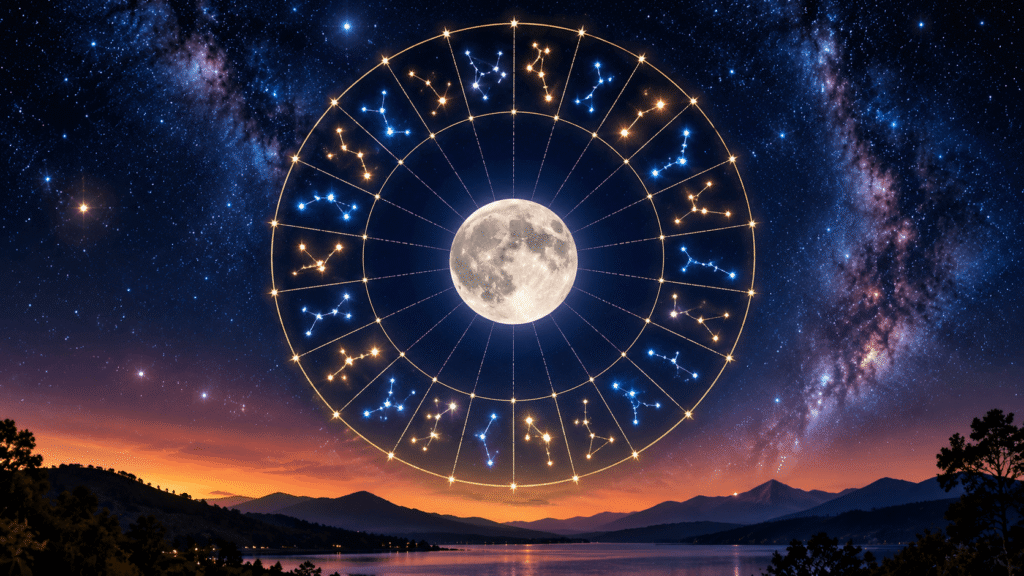
For instance, if a Panchang mentions Rohini Nakshatra at a particular time, it means that the Moon’s calculated position lies within the section assigned to Rohini.
One point worth understanding is that the Nakshatras mentioned in the Panchang are not simply the individual stars we see in the night sky. They are specific divisions of the celestial path used in traditional astronomical calculations. Although their names are associated with groups of stars, the measured divisions and the visible star groups are not exactly the same thing.
The discussion of Nakshatras also brings up another interesting question: Where did the names of Indian months such as Chaitra, Vaishakha, Jyeshtha and Ashadha come from?
Indian months follow different traditional systems of calendar calculation, and the rules for naming them can vary. The National Panchang published by IMD follows the Amanta system for its lunar month calculations. In this system, a lunar month begins on the day following Amavasya, and its name is determined by the Nirayana solar month in which the preceding New Moon occurs.
This is one example of how astronomical observations and traditional calendar practices come together in the Indian system of timekeeping.
5. The Yoga in a Panchang Is Not the Yoga We Practise!
When we hear the word Yoga, most of us immediately think of physical exercises, breathing techniques or meditation. However, the Yoga mentioned in a Panchang has an entirely different meaning.
Here, Yoga refers to a specific astronomical calculation based on the positions of the Sun and the Moon.
To calculate it, their Nirayana longitudes are added together. The resulting value is divided into 27 equal sections, each measuring 13 degrees and 20 minutes. These sections are known as the 27 Yogas.
Some of their traditional names are Vishkambha, Priti, Ayushman, Saubhagya and Shobhana.
These names may sound unfamiliar, but they form an established part of the Panchang’s traditional calculations.
In traditional astrology, each Yoga is assigned a particular meaning and is classified as auspicious or inauspicious. These classifications are considered when selecting timings for certain religious ceremonies and activities.
It is important, however, to distinguish between the astronomical calculation and the traditional beliefs associated with it. The calculation of Yoga is based on measurable celestial positions, whereas claims about its auspicious or inauspicious effects belong to the realm of traditional astrological belief and are not scientifically established.
6. What Is a Karana? Understanding Half of a Tithi
We have now reached the fifth and final element of the Panchang: Karana.
The easiest way to understand Karana is to go back to the calculation of Tithi.
As we have seen, a Tithi is based on a 12-degree increase in the angular distance between the Sun and the Moon. When this 12-degree interval is divided into two equal parts, each part measures 6 degrees.
Each of these half-Tithi periods is called a Karana. In other words, there are two Karana periods within a single Tithi.
There are 11 traditional Karana names in total. Seven of them are movable Karanas, which repeat in a regular sequence:
- Bava
- Balava
- Kaulava
- Taitila
- Gara
- Vanija
- Vishti
The remaining four are fixed Karanas:
- Shakuni
- Chatushpada
- Naga
- Kimstughna
These four occur at specific points in the lunar cycle rather than repeating in the same way as the seven movable Karanas.
Since a Karana represents only half a Tithi, it naturally changes more frequently. This is why the Panchang provides separate beginning and ending times for Tithis and Karanas.
Once the 12-degree and 6-degree calculations are understood, the relationship between these two elements becomes quite simple.
7. How Is the Panchang Useful in Everyday Life?
After learning about all five elements, it is natural to wonder how this information is actually used. Is the Panchang relevant only when a festival approaches, or does it have a wider role?
Think about the preparations that take place before Ganesh Chaturthi. Families decide when to bring home the idol and perform the installation ceremony. During Diwali, people check the appropriate date and time for Lakshmi Puja. Similarly, festivals such as Ram Navami and Janmashtami are observed according to particular Tithis and traditional rules.
This is where the Panchang becomes useful.
Many families also consult it when selecting a Muhurta for weddings, housewarming ceremonies (Griha Pravesh), starting a new business or performing religious rituals. Such decisions are generally guided by traditional astrological and cultural practices.
Apart from religious occasions, the Panchang provides information about astronomical events. Its sunrise, sunset, moonrise and moonset timings help people understand when these events occur at a particular location.
These timings are not identical everywhere. For example, sunrise in Pune may occur at a different time from sunrise in Delhi on the same date. This is why location-specific information matters when consulting a Panchang.
At the same time, it is useful to understand the difference between astronomical information and traditional beliefs. The positions of the Sun and Moon and the calculations based on them can be studied and verified scientifically. However, selecting an auspicious Muhurta does not scientifically guarantee the success of an activity. That aspect belongs to religious faith and cultural tradition.
8. Why Do Different Panchangs Sometimes Show Different Dates for the Same Festival?
This is something many people have probably experienced.
You open one Panchang app on your mobile phone and find that a particular Tithi ends at 10:00 AM. Then you check another app, only to discover that the same Tithi is shown as ending a few minutes earlier or later.
Sometimes, even the festival date itself appears different.
There are several reasons why this can happen.
Different Calculation Methods
Panchangs may use different astronomical calculation methods, reference values and conventions. These differences can sometimes produce small variations in the calculated timings.
Time and Geographical Location
The time standard used for displaying astronomical events also matters. Sunrise and sunset depend on the observer’s geographical location, while the timings of Tithi, Nakshatra and Yoga depend on their astronomical calculations and the time reference used to display them.
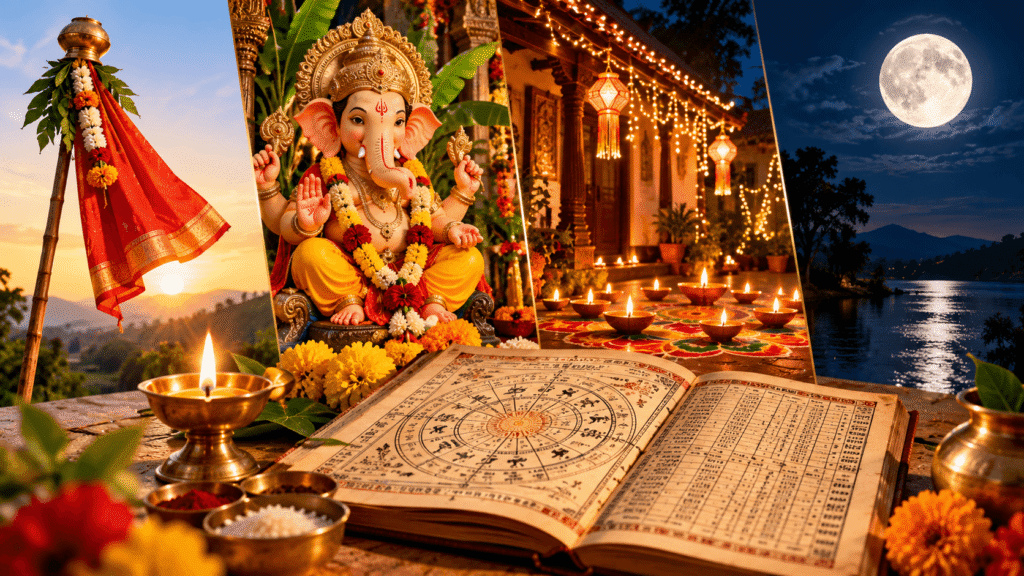
Traditional Rules for Deciding Festival Dates
This is particularly important when understanding why two Panchangs may recommend different festival dates.
Not every festival is decided using the same rule. For some occasions, the Tithi prevailing at sunrise is important. For others, the Tithi present during a particular period of the day, night or a specified ritual time is taken into account. Regional customs and traditional practices can also influence the final decision.
As a result, two Panchangs may sometimes show different dates for the same festival without necessarily making a simple calculation error.
This is why it is better not to rely entirely on a date displayed by a random mobile application when planning an important religious occasion. Checking a reliable local Panchang and understanding the tradition followed in your region can help avoid confusion.
Where Can You Learn More About the Panchang?
If you would like to explore the astronomical calculations behind the Panchang in greater detail, the National Panchang resources published by the India Meteorological Department (IMD), Government of India, are useful starting points.
Here are two official references:
- Explanation of National Panchang – India Meteorological Department (IMD)
Read the official IMD explanation of National Panchang - Information on Tithi and Nakshatra – India Meteorological Department (IMD)
Read the official IMD information on Tithi and Nakshatra
The next time someone at home opens a Panchang to check the Tithi or decide the date of a festival, you will know that there is much more behind those entries than just a traditional list of dates.
The Panchang brings together observations of the Sun and the Moon, mathematical calculations and a system of timekeeping that has developed over centuries. It also reflects how astronomical knowledge became closely connected with everyday life, festivals and cultural traditions in India.
Understanding it gives us a better appreciation of both our heritage and the science of observing the sky.