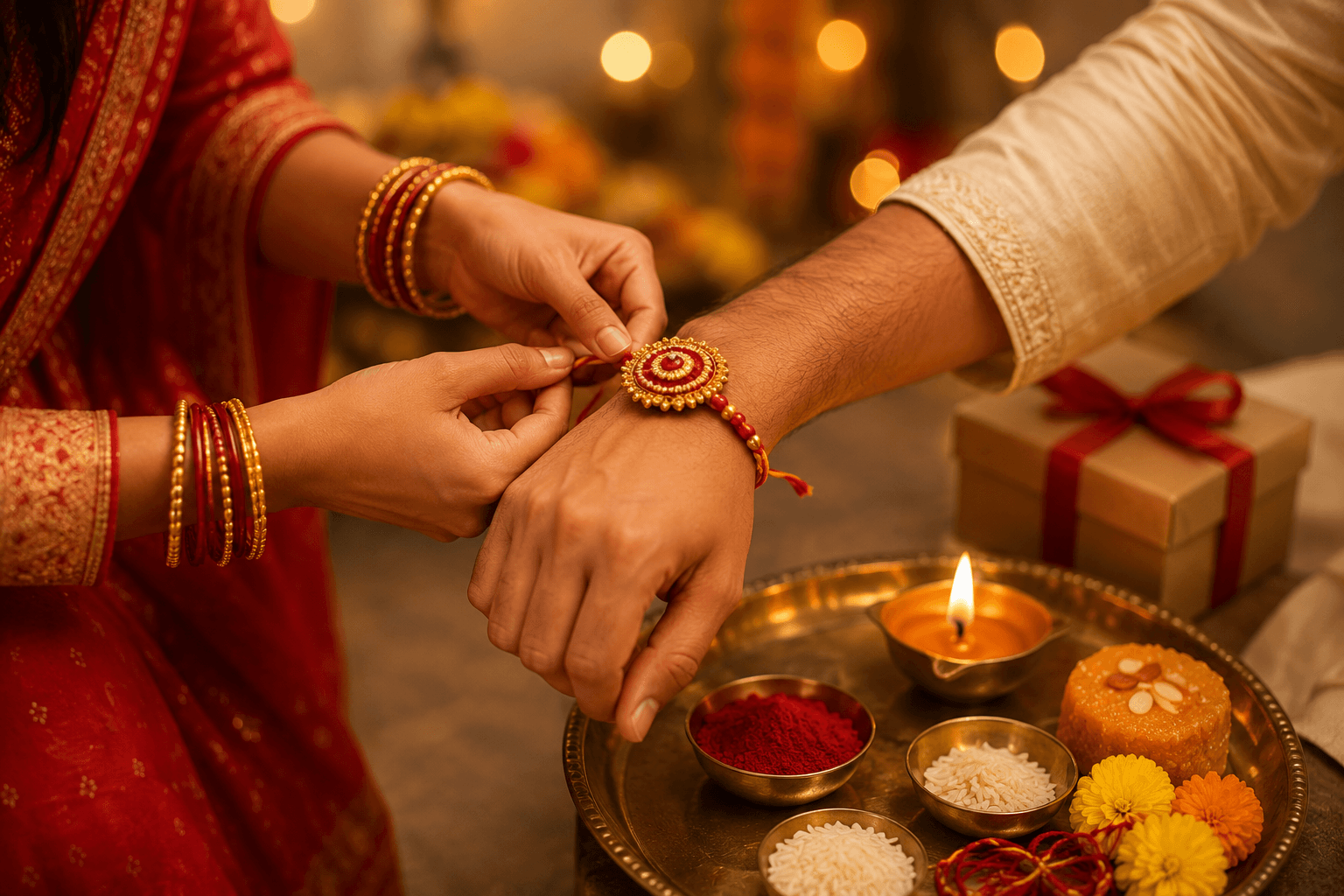
The full moon of Shravan arrives, and homes begin to fill with a quiet, festive warmth. A traditional plate is prepared with vermilion, rice grains, a flickering lamp, and sweets.
A sister ties a rakhi around her brother’s wrist, praying for his happiness, while the brother promises to stand by her through every stage of life.
For us, this is a familiar and deeply comforting sight. But have you ever wondered how a simple piece of thread became so incredibly powerful?
To understand the magic of this thread, we need to look beyond the modern festival and travel back into the ancient cultural traditions of India.
Table of Contents
The Ancient Concept: More Than a Sibling Bond
There is no single historical date that marks the “invention” of Raksha Bandhan.
The tradition we know today blossomed from the ancient practice of tying a ‘Raksha Sutra’ — a sacred thread associated with protection, well-being, and auspiciousness.
The word itself holds its meaning:
Raksha = Protection
Bandhan = Bond
In its original sense, this was not a festival exclusively meant for brothers and sisters. It was a sacred ritual meant to protect anyone heading into danger or starting a new chapter.
Over centuries, this concept beautifully merged with the affection of siblings, creating the festival we celebrate today.
Mythological Legends: The Roots of the Rakhi
Indra and Shachi (The Power of Faith):
According to the Bhavishya Purana, a fierce battle was raging between the gods and the asuras (demons).
Seeing the gods losing, Indra’s wife, Shachi, grew deeply concerned for her husband’s life.
She sought the guidance of Guru Brihaspati, who chanted sacred mantras over a simple thread.
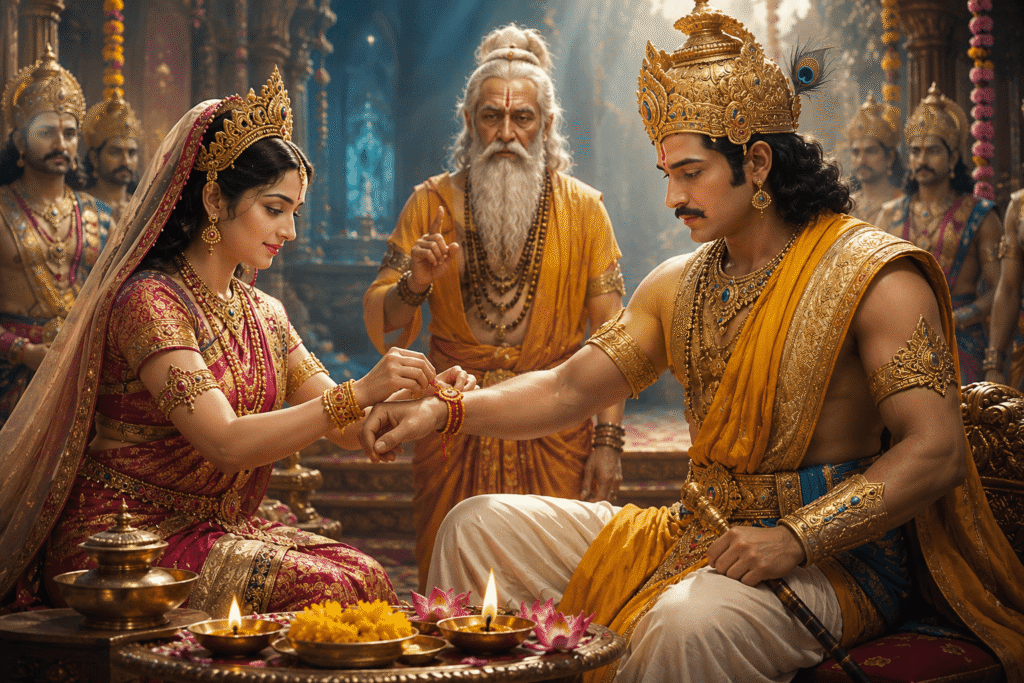
Shachi tied this Raksha Sutra around Indra’s right wrist. Empowered by the thread and his wife’s faith, Indra won the battle.
King Bali and Goddess Lakshmi (The Bond of Trust):
To free Lord Vishnu from a promise made to the demon King Bali, Goddess Lakshmi visited Bali in the guise of an ordinary woman.
She tied a protective thread around his wrist, accepting him as her brother.
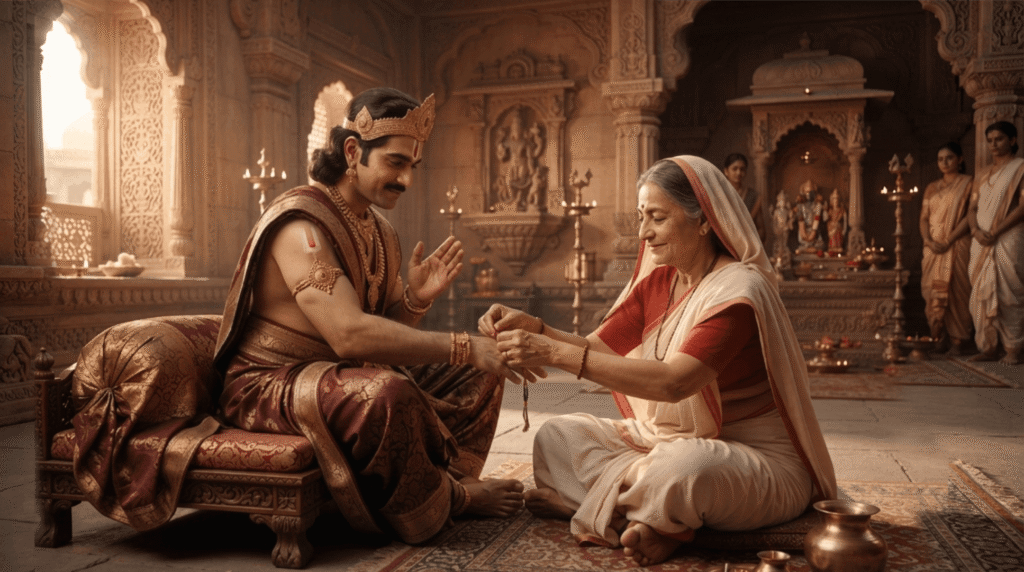
Deeply moved, Bali asked her to seek a gift.
She asked for her husband’s return to Vaikuntha, and Bali kept his word.
This is believed to be why the festival is celebrated on Shravan Purnima.
Shri Krishna and Draupadi
One of the most widely loved and emotionally powerful stories of Raksha Bandhan comes from the Mahabharata, centered around Shri Krishna and Draupadi.
According to the popular tradition, Shri Krishna once injured his finger (after using his Sudarshan Chakra), and it began to bleed profusely.
Seeing this, Draupadi immediately, and without a second thought, tore a piece of cloth from her rich, expensive silk saree and tied it tightly around Krishna’s bleeding wound.
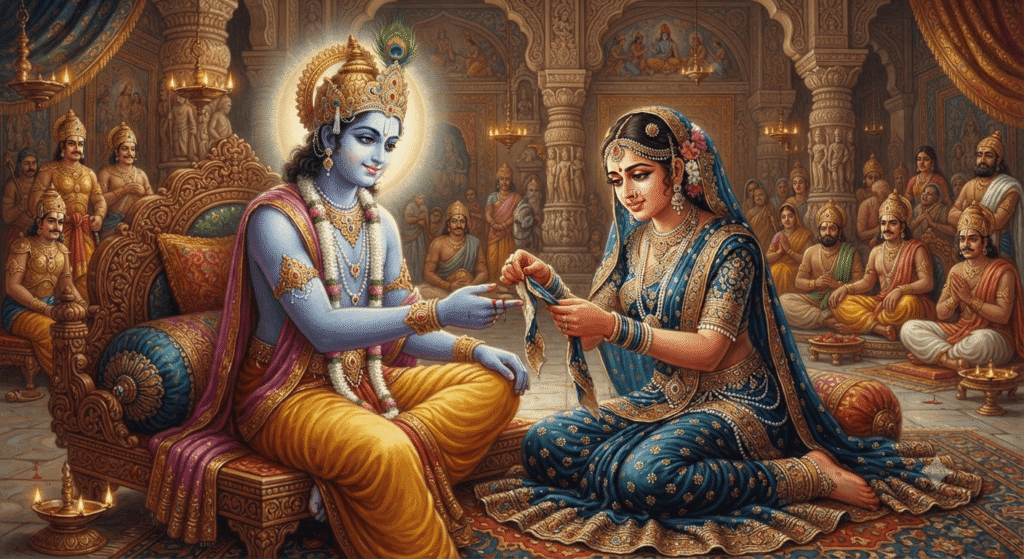
She did not do it expecting anything in return; it was simply an act of pure affection and compassion.
Touched by this selfless act, Krishna promised to protect her forever. He remembered Draupadi’s love and held a deep sense of responsibility toward her.
Later, when Draupadi faced her gravest crisis in the Kaurava court (during the Cheerharan), Krishna kept his promise and miraculously protected her honor.
These ancient stories teach us that a rakhi does not only connect people through birth; it creates a profound bond through acceptance, unconditional love, and mutual trust.
History in the Making: When the Thread United Societies
Rani Karnavati and Emperor Humayun
When the Sultan of Gujarat attacked Mewar, Queen Karnavati found herself heavily outnumbered.
In a desperate bid to save her kingdom, she sent a rakhi to the Mughal Emperor Humayun.
Respecting the sacred bond of the thread, Humayun set aside religious differences and marched with his troops to protect his “sister,” proving that the rakhi transcends blood and faith.
Rabindranath Tagore and the Partition of Bengal
When the British government attempted to divide Hindus and Muslims by partitioning Bengal, Nobel laureate Rabindranath Tagore turned Raksha Bandhan into a powerful tool of resistance.
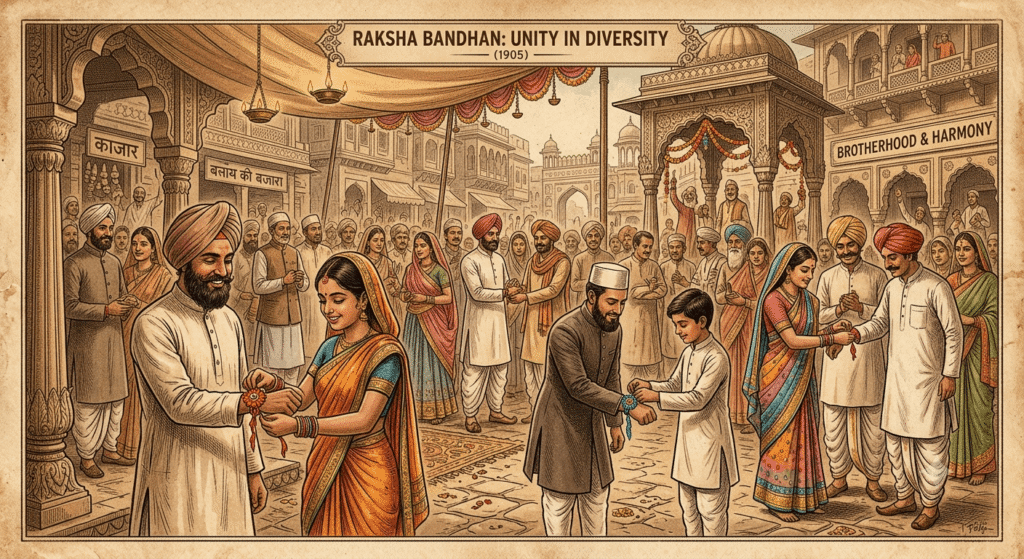
He urged Hindus and Muslims to tie rakhis on each other’s wrists as a symbol of unbreakable social unity.
The thread became a weapon of peace that shook the British “Divide and Rule” policy.
The Modern Rakhi: A Bond of Mutual Support
The way we celebrate Raksha Bandhan today has beautifully evolved. The core emotion remains, but the roles have expanded to fit the modern world:
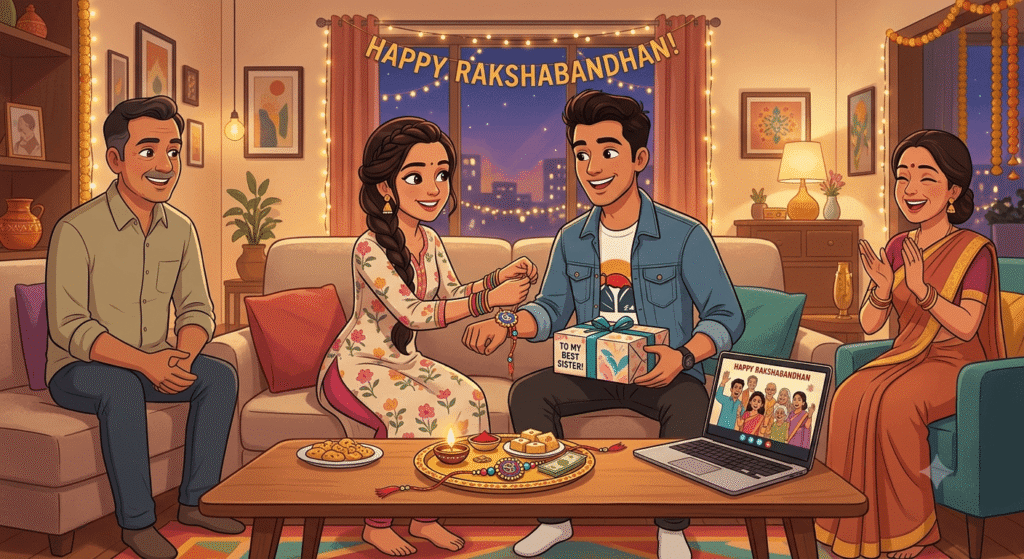
Equality in Protection:
Today’s rakhi no longer just says, “A brother will protect his sister.” It says, “We will always be there for each other.”
Modern sisters are equally fiercely protective of their brothers, making it a festival of mutual emotional support.
Beyond the Family Tree:
The spirit of the festival has broken through the walls of our homes.
Today, rakhis are tied to the wrists of soldiers guarding our borders, acknowledging them as the protectors of the nation.
Protecting Nature:
In a beautiful modern twist, many communities now celebrate Vrikshabandhan, tying rakhis to trees to pledge their commitment to environmental protection.
The True Strength of the Sacred Thread
A rakhi is, ultimately, just a fragile piece of thread. It has neither the sharpness of a sword nor the strength of iron. Yet, it holds an unmatched power.
Why? Because its true strength does not lie in the cotton or the silk—it lies in the emotion with which it is tied. When a sister ties a rakhi, she is tying childhood memories, countless little arguments that ended in laughter, and a silent promise:
“No matter how far life takes us, I am here for you.”
The rakhi has changed, eras have passed, and society has evolved. But the human desire to stand by the people we love remains just as alive today.
Because the rakhi is tied around the wrist… but its true bond is created in the heart.
Which of these legendary Rakhi stories touched your heart the most? Let us know in the comments below! Don’t forget to share this article with your siblings and friends to spread the rich history of this sacred bond.