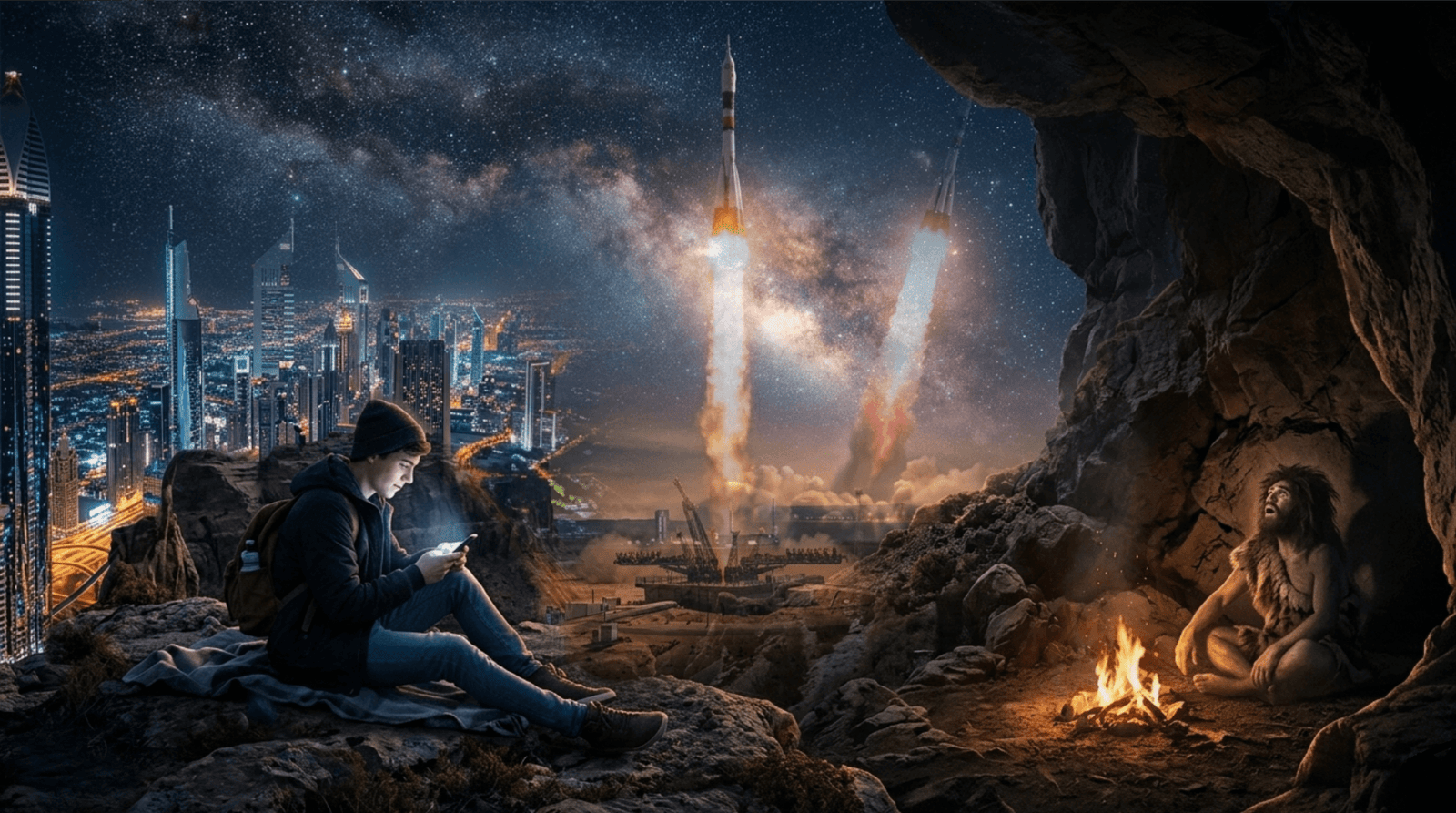
As you hold a smartphone in your hand today, accessing the sum of human knowledge within seconds—have you ever paused to reflect on how it all began?
Millions of years ago, on this very planet, when one of our early human ancestors first looked up at the night sky, what was the very first thought that crossed their mind?
Could they ever have imagined that one day, their descendants would soar through space, study distant stars, and carry a world of knowledge in the palm of their hands?
Hardly.
In that era, the single most overwhelming thought driving human existence was brutally simple:
“How do I stay alive today?”
We have all read about human evolution in history textbooks—how early humans learned to walk upright, mastered fire, and crafted stone tools. But these were not merely static historical events. Behind every milestone lay intense uncertainty, fear, curiosity, and a desperate yet beautiful desire to make sense of the unknown.
Rather than looking at this journey solely through a cold scientific lens, let us experience it through the emotions, fears, questions, and inner world of our early human ancestors.
Table of Contents
- The Birth of a Question: When Did Humans Begin to Truly Wonder?
- The First Fire: A Terrifying Monster Becomes a Source of Wonder
- From Accident to Invention: When Humans Learned to Create
- The Longing for Language: When Thoughts Found a Voice
- Neanderthals and Sapiens: When Two Human Worlds Met
- From the First Spark to Artificial Intelligence: The Ancient Fire Within Us
- The Unending Journey
1. The Birth of a Question: When Did Humans Begin to Truly Wonder?
Imagine living deep in the wilderness, long before thoughts could be expressed through spoken language.
The early human mind operated through raw sensations, emotions, memories, and a constant effort to interpret subtle signals from the surrounding environment.
When a dangerous predator suddenly appeared, two simultaneous reactions may have taken over: a pounding heart born of sheer terror and an instinctive surge of adrenaline driving the urge to flee.
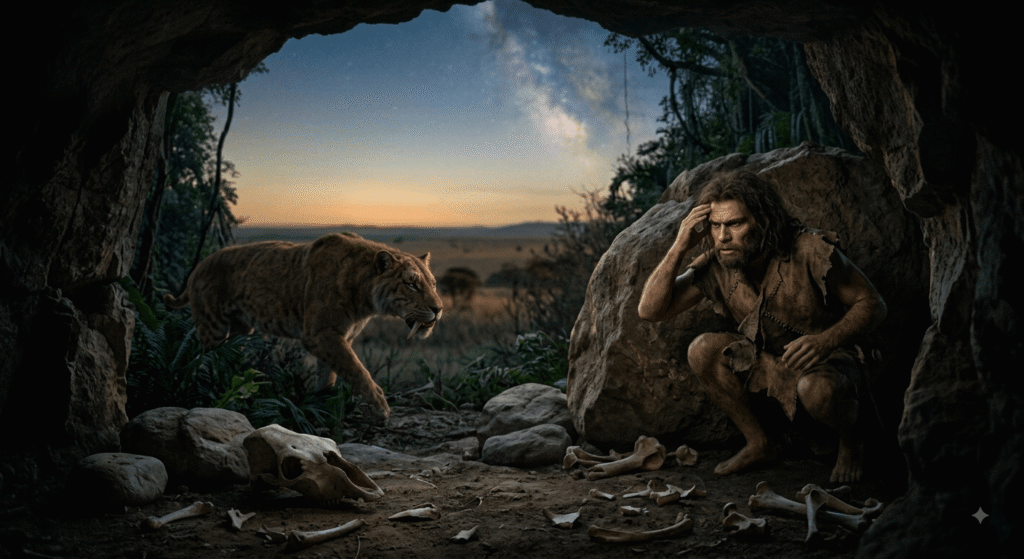
Yet, alongside this primal fear, something revolutionary was quietly taking root:
Curiosity.
While many animals respond to danger primarily through instinct, early humans increasingly developed the ability to pause, observe, remember, and try to understand what they were facing.
They ran.
They stopped.
They turned around.
And they wondered.
«“Why does this predator hunt at night?”»
«“Why does striking one rock against another create such a sharp sound?”»
In the beginning, human thoughts were largely focused on food, shelter, safety, and sleep. But as the brain developed and experiences accumulated, questions began to take shape.
And perhaps that was one of the greatest revolutions in the history of life:
the birth of the question.
2. The First Fire: A Terrifying Monster Becomes a Source of Wonder
Consider what it might have felt like when an early human witnessed a natural fire for the first time.
Picture a pitch-black, stormy night. Thunder shakes the earth, and a bolt of lightning strikes a dry tree.
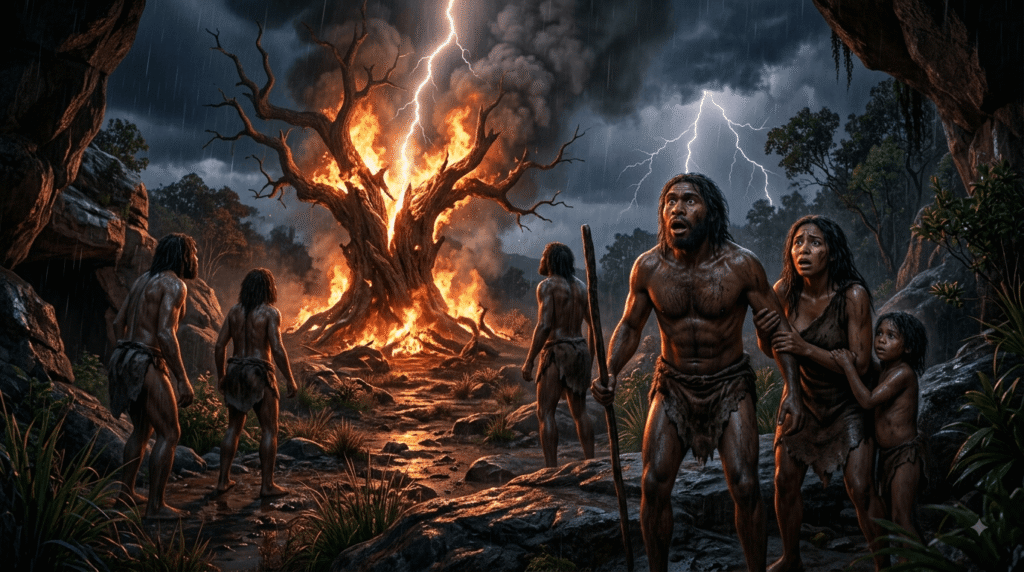
Within seconds, the tree erupts into dancing waves of vivid crimson and gold.
Until that moment, humans had known water, earth, wind, and sky. But suddenly, something completely different was moving before them—a wild, glowing force that could destroy everything around it.
How might that ancient human have reacted?
Their heart may have hammered against their ribs. Their limbs may have trembled as they fled in panic.
Fire was not a comforting source of warmth yet.
It was danger.
It was destruction.
It was an unknown force of nature.
So how did humans eventually make peace with it?
Perhaps, after the panic subsided and only glowing embers remained, one courageous individual cautiously stepped closer.
The flames were gone.
But the warmth remained.
“Wait… this gives off heat.”
Later, when they tasted meat accidentally roasted by the flames—or perhaps discovered how fire changed the taste and texture of food—the experience may have brought another extraordinary realization.
Survival suddenly had flavor.
And a new question may have emerged:
“How can this mysterious force be recreated?”
Mastering fire was certainly not an overnight miracle. It likely required generations of observation, experimentation, imitation, and trial and error.
Then, perhaps one day, while striking stones together, a tiny spark landed on dry grass.
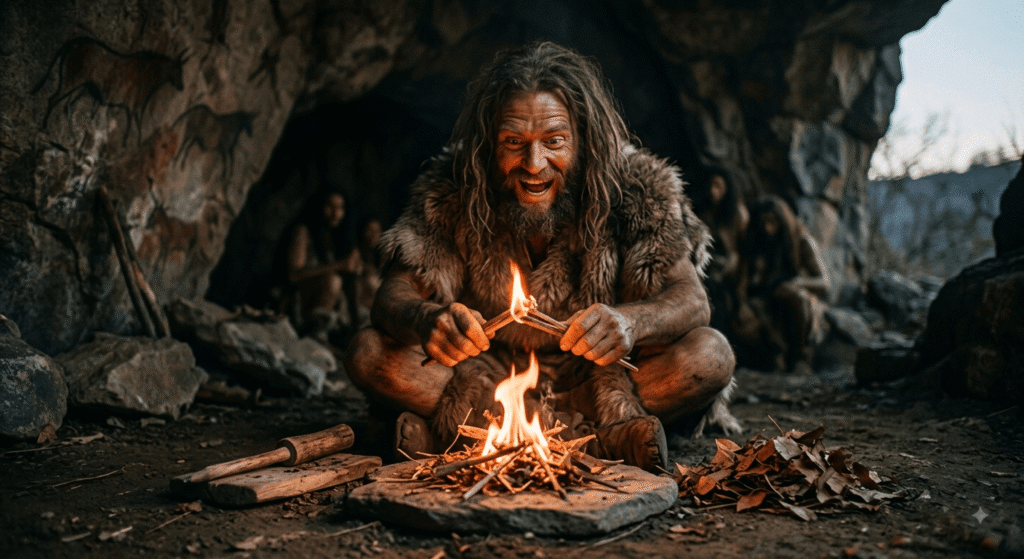
Smoke rose.
The human heart raced—not this time with fear, but with astonishment.
They blew gently on the glowing ember.
A small flame came alive.
Imagine the sheer awe felt by the person who first learned how to deliberately create fire.
Did they shout in excitement ?
Did they feel they had discovered something almost supernatural ?
We can never know.
But one thing is certain: fire had begun to change human life.
It was no longer simply an untamed force of nature.
It had become a source of warmth, light, protection, and cooked food.
3. From Accident to Invention: When Humans Learned to Create
Many ancient innovations were probably not planned inside anything resembling a laboratory.
They emerged through keen observation, accidents, mistakes, experimentation, and persistent trial and error.
Behind every discovery was a human being trying to adapt to the world around them.
So how might the first stone tool have come about?
Perhaps a hunter, overwhelmed by fear or frustration, struck or threw a stone against a larger rock.
The stone shattered.
One fragment was left with a sharp, jagged edge.
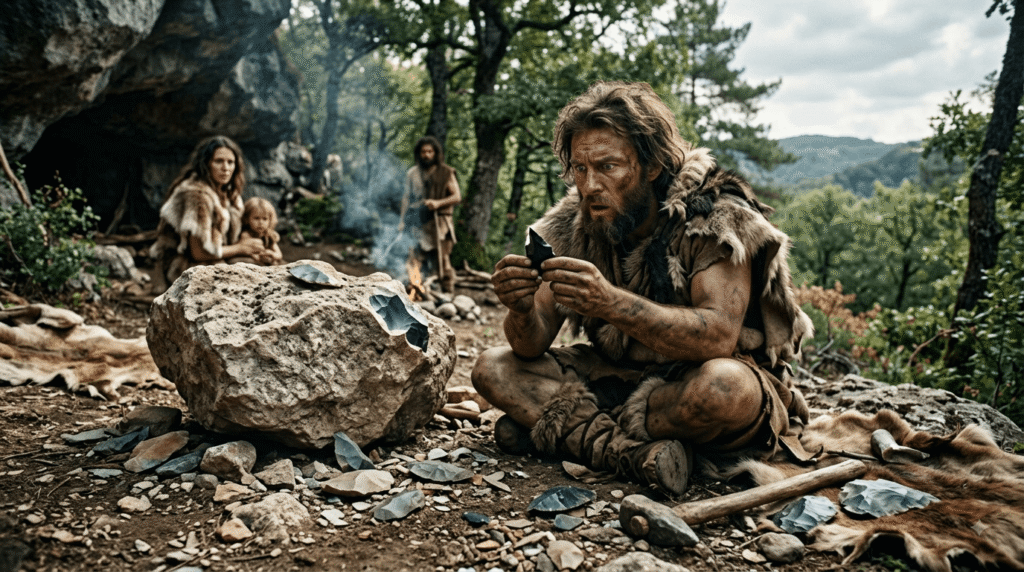
Curiosity took over.
The human picked it up—and perhaps accidentally cut their finger.
It hurt.
But through that brief sting of pain came a monumental realization:
“If this stone can cut my skin, perhaps it can cut through the hide of an animal.”
In that moment, fear may have given way to something completely different:
the thrilling realization of creation.
I made this.
This was more than simply discovering a sharp stone.
It represented an important step in human history.
Early humans were not merely passive victims of nature. They could observe the world, modify materials, and use those materials to solve problems.
They had begun to reshape their environment rather than simply endure it.
4. The Longing for Language: When Thoughts Found a Voice
Imagine having a complex thought burning inside your mind—wanting to tell someone:
“Tomorrow morning, let us hunt behind that distant mountain because there may be plenty of food there.”
But having no words to express it.
The inner world of early humans may have been rich with emotions, memories, intentions, and ideas, yet communication was initially limited by gestures, facial expressions, body language, and vocal sounds.
Sitting around a fire at night—or mourning the loss of a loved one—the inability to fully communicate complex thoughts must have been deeply frustrating.
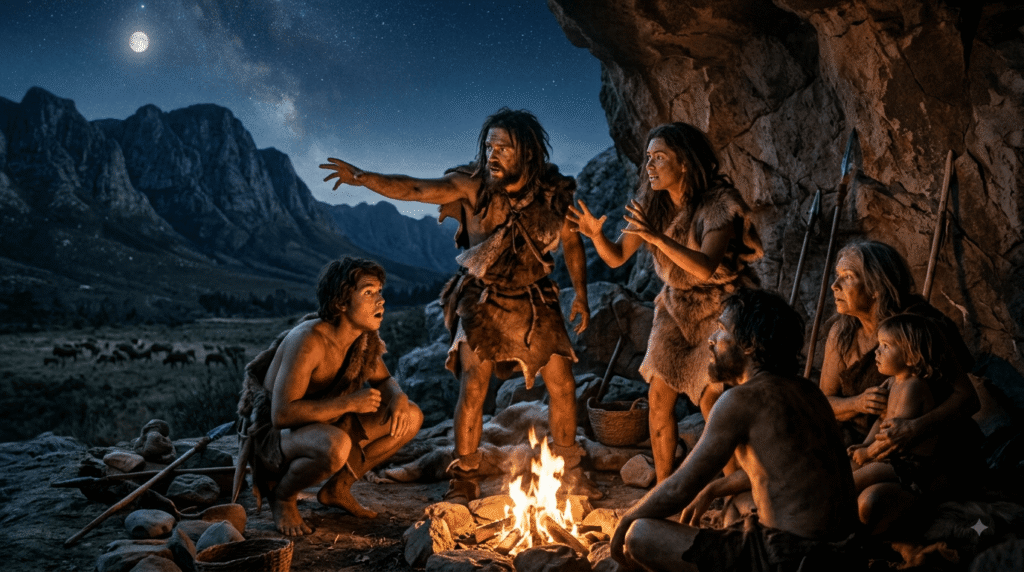
Over thousands of years, survival and social cooperation demanded increasingly precise signals.
A particular sound could refer to an animal.
Another could signal danger.
A sudden cry could mean:
“Run!”
Modern scientific research has highlighted the importance of genes such as FOXP2 in the development of human speech and language abilities. However, language did not suddenly appear because of a single genetic change.
It emerged through a long and complex interaction between brain development, vocal anatomy, social cooperation, learning, and evolutionary change.
And somewhere along that immense journey, humans became increasingly capable of transferring detailed thoughts from one mind to another.
Language built a bridge between isolated minds.
And once knowledge could be shared through increasingly sophisticated communication, it no longer had to die with the person who discovered it.
It could be remembered.
It could be taught.
It could be improved.
And it could be passed to the next generation.
5. Neanderthals and Sapiens: When Two Human Worlds Met
Today, Homo sapiens are the only surviving human species on Earth.But for tens of thousands of years, our ancestors shared the planet with other human groups, including the Neanderthals.
Neanderthals were physically robust, well adapted to harsh environments, skilled hunters, and capable of sophisticated social and cultural behavior.
Now imagine a Homo sapiens hunter moving through a dense forest and suddenly coming face-to-face with a Neanderthal.
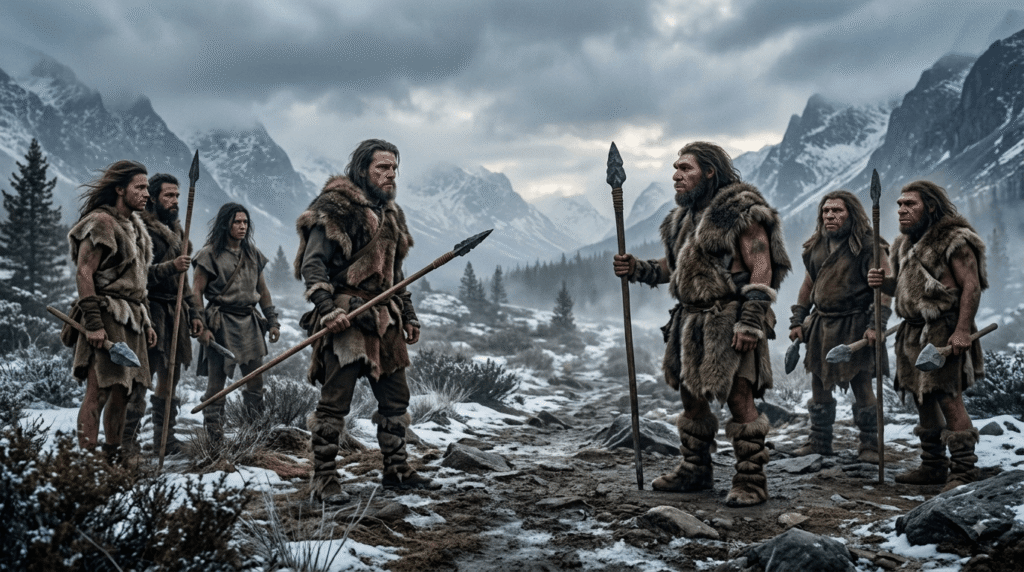
How might that encounter have unfolded?
Suspicion?
Fear?
Curiosity?
Perhaps all three.
Their interactions were not necessarily defined by conflict alone. Evidence points to periods of contact, coexistence, and interbreeding.
Genetic studies have also shown that many modern human populations outside Africa carry some Neanderthal DNA.
Their story, therefore, is not simply an “us versus them” story.
It is part of our shared human history.
Neanderthals did not simply disappear overnight. Their eventual decline was likely influenced by a combination of factors, including climate change, competition for resources, population size, demographic changes, and interactions with Homo sapiens.
Meanwhile, Homo sapiens possessed an extraordinary capacity for cooperation, communication, flexible planning, cultural learning, and passing knowledge from one generation to another.
The story of Neanderthals reminds us of something important:
human evolution was never simply a contest of physical strength.
Adaptability, cooperation, learning, and collective knowledge mattered just as much.
6. From the First Spark to Artificial Intelligence: The Ancient Fire Within Us
Now fast-forward to the modern world.
When an early human first learned to control fire, they could never have imagined that one day, descendants of their species would use controlled energy to launch machines beyond Earth.
When an ancient human pressed a pigment-covered hand against a cave wall, they could never have imagined a future in which their descendants would create digital art on glowing screens.
Yet, beneath all these technological transformations, something fundamental remains unchanged.
The same restlessness, uncertainty, and relentless curiosity that may have burned in the minds of our ancient ancestors still exists within us today.
The Stone Age human stepped outside a shelter, looked up at the star-filled sky, and may have wondered:
“What lies up there?”
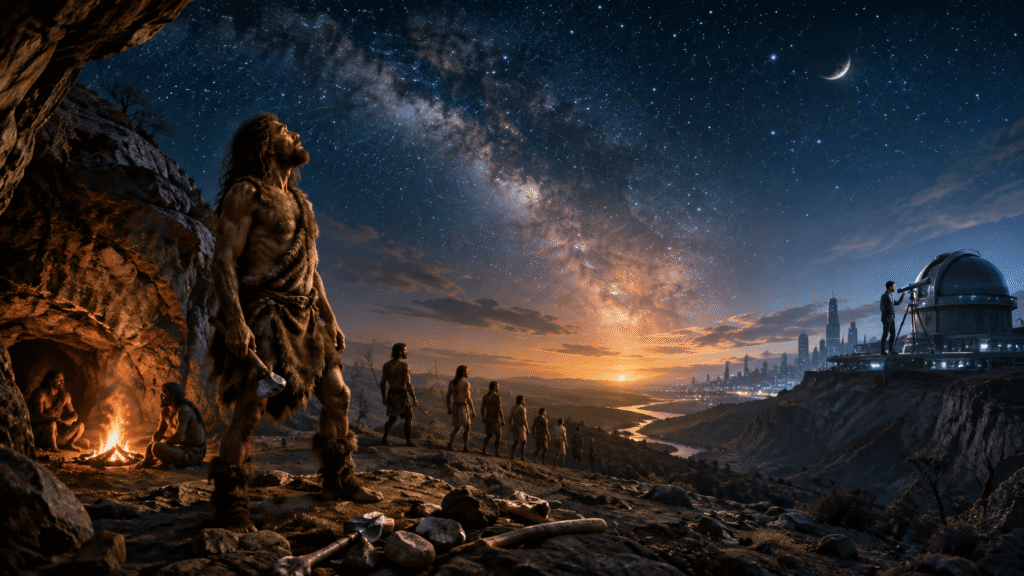
Thousands of generations later, an astrophysicist points a powerful telescope toward distant galaxies and asks:
“Is anyone out there?”
The scale of our questions has expanded.
But the hunger for discovery remains.
First came stone tools.
Then fire.
Then the wheel.
Then written language.
Then machines.
Then electricity.
Then computers.
Then smartphones.
And now, artificial intelligence.
The tools continue to evolve.
But the questioning mind behind them remains remarkably familiar.
The Unending Journey
We stand at the height of modern civilization because, millions of years ago, our ancestors began doing something extraordinary.
They did not always run from the unknown.
Sometimes, they stopped and looked.
Someone looked at fire and wondered how to control it.
Someone looked at a broken stone and saw a tool.
Someone made a sound and gave it meaning.
Someone remembered what another person had discovered and passed that knowledge forward.
And eventually, someone looked at the stars and dared to ask:
“Why?”
Our history is therefore not merely a record of physical changes.
It is also the story of curiosity overcoming fear, knowledge overcoming uncertainty, and imagination transforming survival into civilization.
That is why we still gaze at the night sky.
That is why we continue to ask questions.
That is why we explore places we have never seen, study things we cannot touch, and build technologies our ancestors could never have imagined.
And perhaps that is the most remarkable part of the human story:
the greatest evolution of the human mind may still be far from over.
”What is one question about human evolution or our future that keeps your curiosity alive? Drop your thoughts in the comments below, and share this article with someone who loves to explore the unknown!”