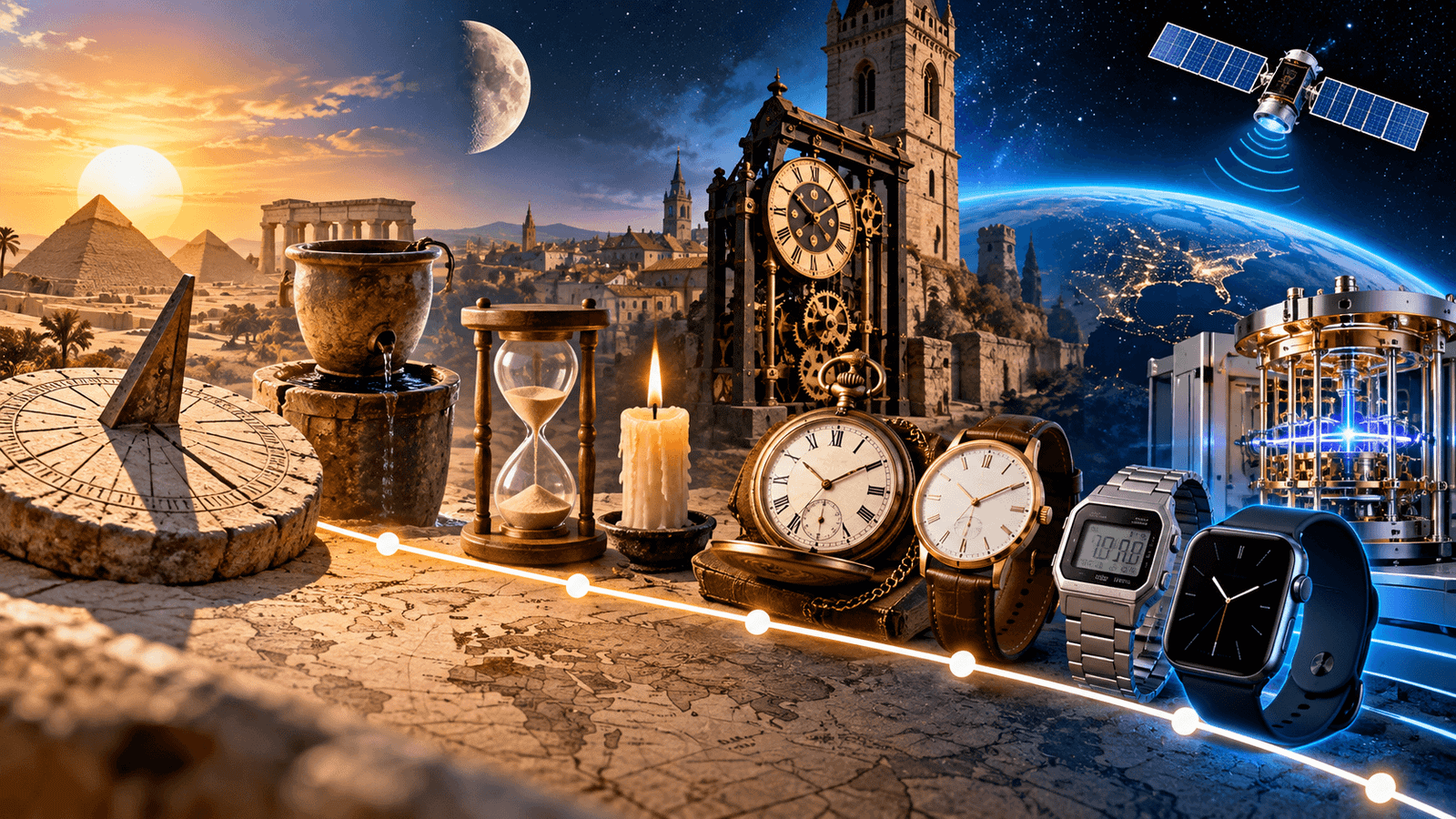
Think about how often you check the time in a single day. You might look at your phone as soon as you wake up, check your watch before leaving for work, or glance at a clock to make sure you are not late for an appointment. Knowing the time has become such a normal part of life that most of us rarely stop to think about it.
But have you ever wondered how people kept track of time thousands of years ago, when clocks, mobile phones and electricity did not exist? Who invented the first clock? Why does an hour have 60 minutes and a minute have 60 seconds? And how can a modern atomic clock measure time with extraordinary precision?
I started wondering about these questions myself. When I began exploring the history of clocks, I discovered something fascinating: the simple act of checking the time today is connected to thousands of years of human observation, experimentation and scientific progress.
The story is much more interesting than I expected. So, let us travel back in time and discover how humans went from watching the Sun’s shadow to measuring seconds using the behaviour of atoms.
Table of Contents
- Why Did Humans Need to Measure Time?
- How Did People Tell Time Before Clocks Existed?
- The Sundial: Turning Shadows into a Way to Tell Time
- How Did People Measure Time After Sunset?
- Why Does an Hour Have 60 Minutes and a Minute Have 60 Seconds?
- The Rise of Mechanical Clocks
- From Pocket Watches to Wristwatches
- The Quartz Revolution and Digital Clocks
- What Is an Atomic Clock, and Why Is It So Accurate?
- Why Do GPS and Mobile Technology Depend on Accurate Time?
- How Is Standard Time Maintained in India?
- Interesting Facts About the History of Clocks
- Conclusion: A Clock Is More Than a Device That Tells Time
- References and Further Reading
1. Why Did Humans Need to Measure Time?
Today, our lives revolve around schedules. We plan when to wake up, go to work, attend classes, catch a train or meet someone. But life was very different for early humans. They had no clocks or fixed timetables, yet understanding the passage of time was essential.
There were several reasons for this.
Farming and the Changing Seasons
When humans began practising agriculture, they needed to understand when to sow seeds, when to harvest crops and how to prepare for seasonal changes. Observing the Sun, the length of daylight and recurring weather patterns helped them recognise the right time for different farming activities.
Organising Daily Life
Before artificial lighting became common, daylight played a major role in everyday activities. People needed to recognise when the day was beginning, when there was enough light to work and when darkness was approaching.
Trade and Community Life
As settlements grew into villages and towns, trade and social activities became more organised. People increasingly needed ways to coordinate meetings, markets, journeys and shared work.
Religious Ceremonies and Festivals
Many ancient cultures observed the Sun, Moon and stars to determine important dates and organise religious ceremonies and festivals. These observations encouraged the development of calendars and more systematic ways of tracking time.
In other words, humans did not originally need a watch to wear on their wrists. They needed to understand the natural world and organise their lives around its rhythms.
2. How Did People Tell Time Before Clocks Existed?
Imagine living in a world without a phone, a wristwatch or a clock on the wall. How would you know whether it was morning, midday or evening?
For early humans, nature provided the first clues.
The Sun and Its Shadow
People learned to recognise the stages of the day by observing the Sun. Sunrise marked the beginning of daylight, the Sun’s position in the sky helped indicate the middle of the day, and sunset signalled the approach of night.
The shadow cast by a standing object changes as the Sun appears to move across the sky. Shadows are generally longer in the morning and evening and shorter around midday, depending on the location and season.
By observing these changes, people could estimate the time of day without needing a mechanical device.
The Moon and Its Phases
The Moon does not look the same every night. Sometimes it appears as a thin crescent, sometimes as a half-circle and sometimes as a full Moon. Over time, the visible portion changes through a repeating cycle.
By observing these phases, ancient people could recognise patterns that helped them estimate the length of a lunar month.
Archaeologists have also discovered markings on ancient bones and other objects that some researchers believe may have been used to record recurring natural patterns, possibly including lunar cycles. However, the meaning of every such marking is not certain.
These observations remind us that the history of timekeeping began long before machines existed. It began with people paying attention to nature and learning from what they saw.
3. The Sundial: Turning Shadows into a Way to Tell Time
Watching the Sun could provide a rough idea of the time, but people eventually developed tools to make these observations more systematic. One of the best-known early timekeeping devices was the sundial.
Ancient Egyptians used shadow-based timekeeping devices thousands of years ago. A sundial generally works by using the shadow cast by a raised object onto a surface marked with lines or divisions. As the Sun’s apparent position changes, the shadow moves, indicating the approximate time.
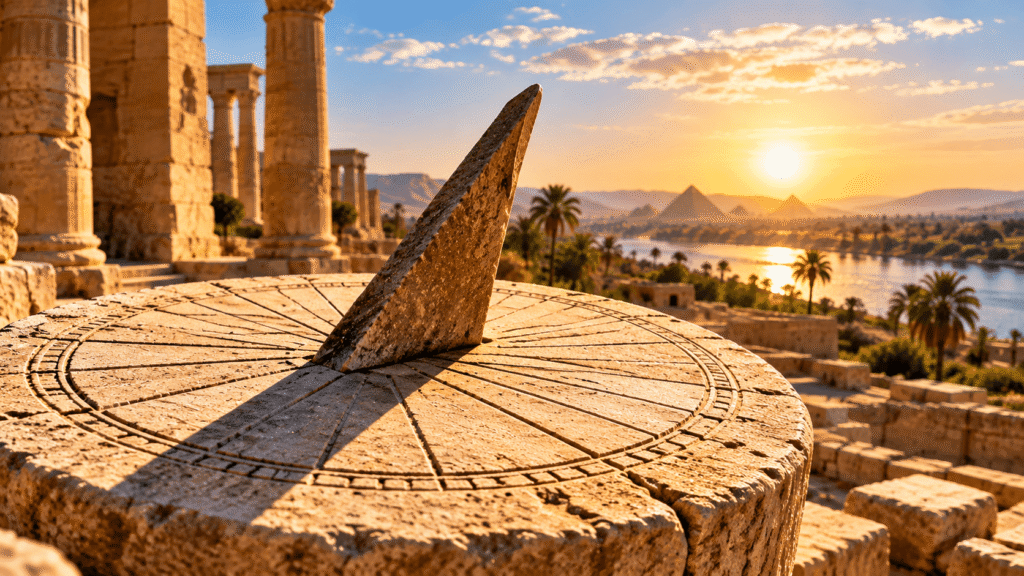
Sundials were a major step forward because they turned a natural observation into a practical measuring tool.
However, they had an obvious limitation: they depended on sunlight. A sundial could not provide a useful reading at night, and heavy cloud cover could make it difficult to use. Its accuracy also depended on its design, orientation and location.
There is another interesting detail about early timekeeping. In some ancient systems, daylight and nighttime were each divided into 12 parts. Because the length of daylight and darkness changes with the seasons, these hours were not always equal in duration.
The equal-length hours we commonly use today developed through later advances in timekeeping.
4. How Did People Measure Time After Sunset?
A sundial was useful during the day, but people also needed ways to measure time when the Sun was not visible. This led to several other ingenious devices.
Water Clocks
Water clocks measured time through the controlled movement of water.
In some designs, water flowed out of a vessel at a measured rate. In others, water collected in a container, and its changing level was used to estimate how much time had passed.
Water clocks were used in ancient Egypt and other civilisations. India also had traditional water-based timekeeping methods, including the ghatika-patra, which used a vessel and water to measure intervals of time.
These devices were useful, but their accuracy could be affected by the vessel’s shape, the water level and the rate of flow.
Hourglasses
An hourglass contains two chambers connected by a narrow passage. Sand gradually falls from the upper chamber into the lower one. The time required for the sand to pass through provides a way to measure a fixed interval.
Despite the name, not every hourglass measures one hour. Different designs can measure a few minutes, half an hour or other specific durations.
Hourglasses became useful in situations where people needed to measure a defined period without depending on sunlight or a continuously operating mechanism.
Candle Clocks
In some historical timekeeping methods, candles of a particular size were marked at regular intervals. As the candle burned, the changing level helped indicate how much time had passed.
However, the burning rate could vary because of airflow, the type of wax and other conditions. Candle clocks therefore provided estimates rather than perfectly precise measurements.

All these devices shared the same basic idea: use a process that changes in a reasonably regular way to measure the passage of time.
5. Why Does an Hour Have 60 Minutes and a Minute Have 60 Seconds?
This is one of the most interesting questions about the way we measure time. Why did people settle on 60 minutes per hour instead of 100?
The answer lies partly in ancient mathematics and astronomy.
The ancient Babylonians used a number system based on 60. This system was practical because 60 can be divided evenly by many numbers, including 2, 3, 4, 5 and 6. That made it useful for mathematical calculations and astronomical observations.
Over centuries, astronomical traditions helped establish the subdivisions that eventually became familiar to us. The hour came to be divided into 60 minutes, and the minute into 60 seconds.
This was not the work of a single inventor. The system developed gradually through mathematical and astronomical practices over a long period.
Today, we take these divisions for granted, but they are part of a much older intellectual tradition.
6. The Rise of Mechanical Clocks
Sundials and water clocks were useful, but they had limitations. People needed devices that could measure time more consistently without depending on sunlight or the movement of water.
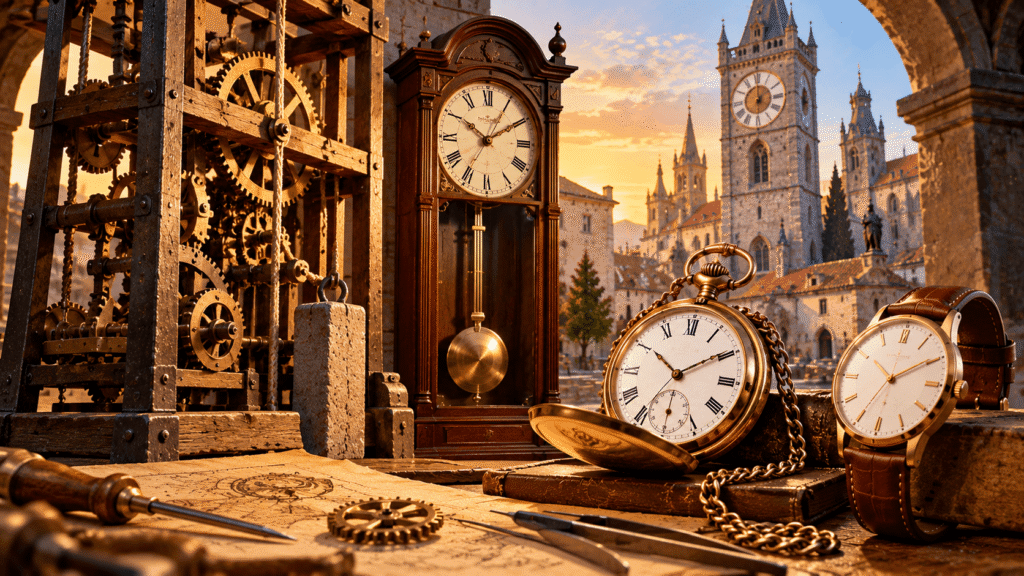
Mechanical clocks began to emerge in medieval Europe around the 13th and 14th centuries. Early designs used mechanical components such as metal gears, weights and regulating mechanisms.
Large clocks were often installed in church towers and public buildings. Some announced the time by striking bells, allowing people nearby to hear when a particular hour had arrived.
These clocks changed how communities organised their daily lives. People no longer needed to interpret the Sun’s shadow or check the level of water to get an indication of the time.
However, early mechanical clocks were not as accurate as modern clocks. Improving their reliability required further inventions and refinements.
How the Pendulum Improved Clock Accuracy
In 1656, Dutch scientist Christiaan Huygens developed a pendulum clock. A pendulum swings back and forth in a regular pattern, and its motion can be used to regulate a clock’s mechanism.
This development significantly improved the accuracy of timekeeping compared with many earlier mechanical designs. Further improvements followed, making clocks increasingly useful for scientific observations and everyday timekeeping.
The pendulum clock was an important milestone because it helped make mechanical timekeeping more dependable.
7. From Pocket Watches to Wristwatches
As clockmaking improved, it became possible to make smaller mechanisms that people could carry with them.
Portable clocks appeared in Europe during the 16th century, and pocket watches became increasingly popular in later periods. Making these small mechanisms was difficult and expensive, so pocket watches were often associated with wealth and social status.
Wristwatches also existed before the First World War. However, the war helped make them more popular, particularly because soldiers needed to check the time quickly without taking a watch out of their pockets.
A watch worn on the wrist was more convenient in situations where speed and coordination mattered. Over time, wristwatches moved beyond military use and became common everyday accessories.
This was another major shift in the history of timekeeping: clocks were no longer limited to public spaces or objects carried in a pocket. They could be worn and checked throughout the day.
8. The Quartz Revolution and Digital Clocks
The 20th century brought a major change in clock technology. Electronic components began replacing many of the traditional mechanical systems used in watches.
How Does a Quartz Clock Work?
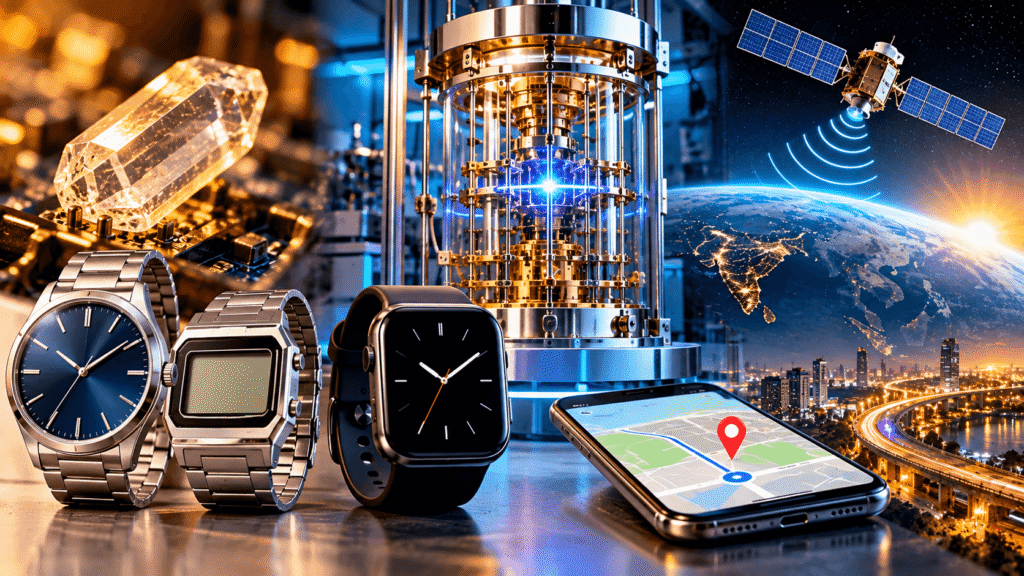
Quartz is a type of crystal that can vibrate at a highly consistent frequency when an electrical voltage is applied to it.
A typical quartz watch uses a crystal that vibrates 32,768 times per second. An electronic circuit counts these vibrations and converts them into regular signals that can be used to keep time.
On 25 December 1969, Japanese watchmaker Seiko introduced the Quartz Astron 35SQ, widely recognised as the world’s first commercially available quartz wristwatch.
It was considerably more accurate than many mechanical wristwatches of its time. As manufacturing techniques improved, quartz technology helped make accurate watches more accessible to ordinary consumers.
This development transformed the watch industry. Accurate timekeeping no longer required every watch to depend on a complex mechanical movement.
Digital Clocks
Digital clocks display the time using numbers rather than traditional moving hands. Many also include features such as alarms, stopwatches and countdown timers.
Today, digital time displays are found in smartphones, computers, cars and countless electronic devices. Checking the time has become easier than ever, and many devices can synchronise their clocks with external time sources.
Yet behind the simple numbers on a screen is the same fundamental challenge that humans have faced for thousands of years: measuring the passage of time reliably.
9. What Is an Atomic Clock, and Why Is It So Accurate?
Atomic clocks represent one of the most important achievements in modern timekeeping.
Traditional clocks use mechanisms such as pendulums or quartz crystals to create regular intervals. Atomic clocks, by contrast, use a precisely defined frequency associated with transitions between energy states in particular atoms.
These atomic properties provide an exceptionally stable reference for measuring time.
In 1967, the international definition of the second was based on the frequency associated with the caesium-133 atom. One second was defined as the duration of 9,192,631,770 cycles of the radiation corresponding to a specific transition in that atom.
That number may seem extraordinary, but it is central to the modern scientific definition of a second.
Atomic clocks are not all equally accurate, and different designs have different performance levels. Nevertheless, they provide some of the most precise time measurements available.
Their importance extends far beyond scientific laboratories. Highly accurate timekeeping is essential for satellite navigation, telecommunications, scientific research and many modern technologies.
10. Why Do GPS and Mobile Technology Depend on Accurate Time?
Have you ever opened a map on your phone and watched it identify your location within moments? Satellite navigation systems make this possible by combining signals from multiple satellites.
GPS satellites transmit signals containing precise timing information. A receiver estimates how long each signal took to arrive and uses that travel time to calculate its distance from the satellite.
By combining measurements from several satellites, the receiver can determine its position.
Even a very small timing error can cause a significant distance error because radio signals travel at approximately the speed of light. This is why precise timing is so important for satellite navigation.
Atomic clocks aboard navigation satellites help provide the necessary timing accuracy. Ground-based systems also monitor and maintain the broader timing infrastructure.
Your phone does not need its own atomic clock to use GPS. Instead, it processes the signals received from satellites and performs calculations to estimate its location.
This is a remarkable example of how a scientific development in timekeeping supports something millions of people use every day.
11. How Is Standard Time Maintained in India?
If you live in India, the time displayed on your clock or phone normally follows Indian Standard Time, commonly abbreviated as IST.
Because the Earth rotates, sunrise and sunset occur at different times in different locations. If every city used a separate official time, coordinating trains, flights, businesses and communication systems would become unnecessarily complicated.
Standard time solves this problem by providing a common time reference for a large region.
Indian Standard Time is 5 hours and 30 minutes ahead of Coordinated Universal Time, or UTC. For example, when it is 12 noon UTC, it is 5:30 p.m. in India.
IST is based on the standard meridian at 82.5 degrees east longitude. Using one standard time helps people and organisations across India coordinate their activities.
Historically, people in India also used observations of the Sun and traditional timekeeping methods, including water-based devices. Today, standard time is essential for transport, banking, communications and everyday activities.
12. Interesting Facts About the History of Clocks
Here are a few details worth remembering from this journey through timekeeping.
- Sundials depend on sunlight. They are not useful at night and can be difficult to read under heavy cloud cover.
- Ancient hours were not always equal in length. In some systems, daylight and nighttime were each divided into 12 parts, so the duration of an hour could change with the season.
- Not every hourglass measures an hour. Its design determines the specific interval it measures.
- Quartz watches count vibrations too. Instead of relying on a swinging pendulum, they use the regular vibrations of a quartz crystal.
- Atomic clocks help define the scientific second. The modern definition of the second is based on a specific frequency associated with the caesium-133 atom.
Each of these developments reflects the same human goal: finding better ways to measure time and make those measurements more reliable.
Conclusion: A Clock Is More Than a Device That Tells Time
As I explored the history of clocks, one thing became clear to me: something we use so casually today has a remarkably long and fascinating history.
Humans first estimated the time by observing the Sun and its shadows. They later developed water clocks, hourglasses and candle clocks. Mechanical clocks made timekeeping more systematic, pendulum clocks improved accuracy, and portable watches allowed people to carry time with them.
The arrival of quartz watches and digital displays made accurate timekeeping more accessible. Atomic clocks then took precision to an entirely new level.
No single person invented the complete clock we use today. It evolved through the observations, experiments and discoveries of people across different civilisations and generations.
Today, we check the time on our phones, navigate unfamiliar roads using GPS and communicate instantly with people across the world. Accurate timekeeping quietly supports many of these everyday conveniences.
Thousands of years ago, humans looked at the Sun’s shadow to estimate the time. Today, scientists use the behaviour of atoms to measure a second.
That journey is a powerful reminder of what curiosity, careful observation and scientific progress can achieve.
So, the next time you glance at your watch or phone, take a moment to think about the remarkable history behind that simple display.
What do you think? How might timekeeping technology change in the future? Share your thoughts and questions in the comments.
References and Further Reading
The following sources provide additional information about the historical and scientific developments discussed in this article.
- National Institute of Standards and Technology (NIST) — Timekeeping and Clocks FAQs
- NIST — A Brief History of Atomic Time
- NIST — How Do You Measure a Second?
- NIST — Second: The Past
- Smithsonian National Museum of American History — Seiko Quartz Wristwatch
Note: Some details about ancient timekeeping remain uncertain, including the exact dates and purposes of certain early objects. Where the evidence is inconclusive, this article avoids presenting a theory as an established fact.